
Driving Lessons for Beginners: What to Expect in 2026
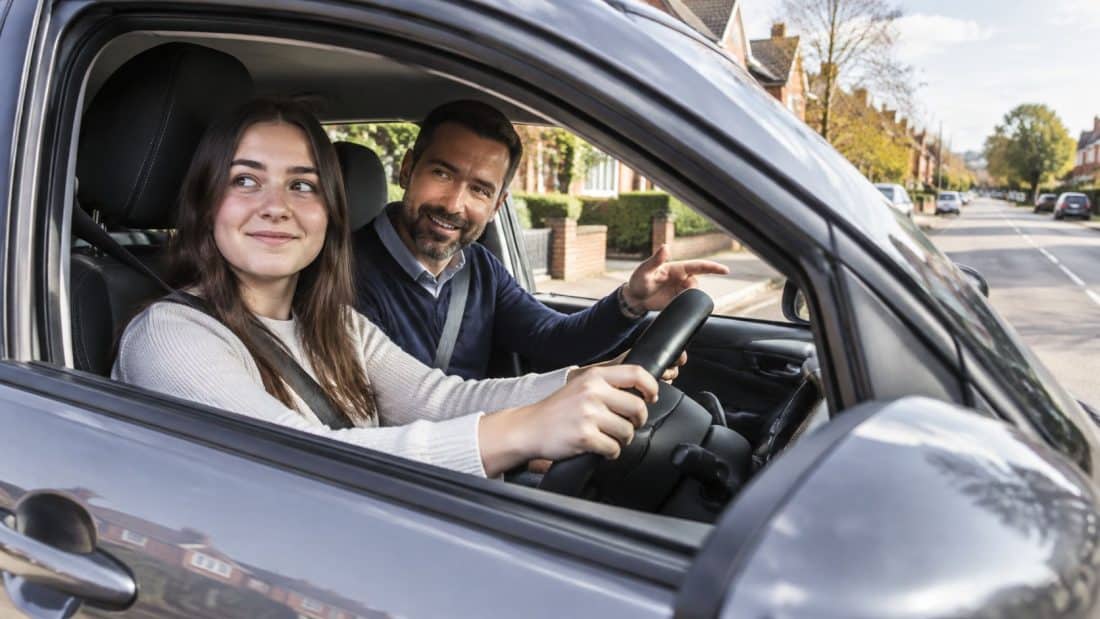
You've booked a lesson, or you're hovering over the booking form, wondering how you'll steer, change gear and watch the road at the same time. You might also be worrying about stalling while someone waits behind you. Those are reasonable concerns when everything inside the car still feels unfamiliar.
Good driving lessons for beginners break that workload into manageable tasks. Your learning plan should also stretch beyond the test date, covering how you'll maintain your skills while waiting and build experience once you're driving alone.
Table of Contents
- What Happens in Your First Driving Lesson
- How Lessons Progress from Basics to Test Standard
- Choosing Between Manual and Automatic Lessons
- What Lessons Cost and How Many You Need
- Calming Nerves Before and During Lessons
- Keeping Skills Sharp While You Wait for a Test
- Driving Alone After You Pass
- Book Your First Lesson With a Clear Plan
What Happens in Your First Driving Lesson
As you settle into the driver's seat, the car may feel unfamiliar before it even moves. Your instructor will check your provisional licence and any requested identification, check your eyesight, and ask about your experience. Bring glasses or contact lenses if you need them.
First, get comfortable with the stationary car. Adjust the seat so you can operate the pedals properly, set the mirrors, and learn where the controls are. You can ask questions before setting off.
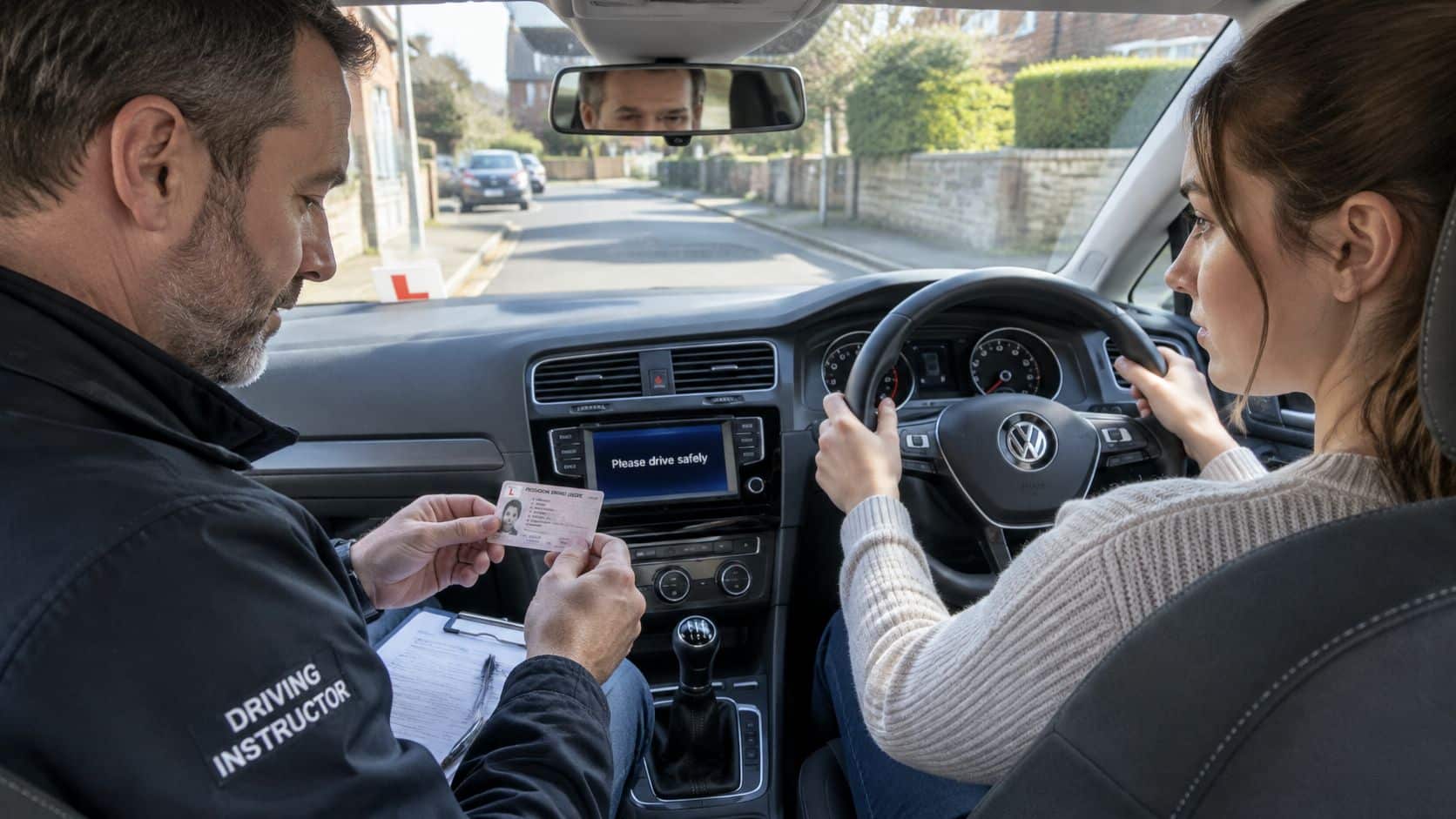
On a suitable quiet road, you'll practise moving off, steering and stopping. Your instructor will talk you through the observations to make before changing speed or direction, while gauging your starting point. You aren't expected to drive perfectly.
Theory and practical tests are separate assessments, so each needs its own preparation. Feeling clumsy or mentally tired after your first lesson is a normal response to concentrating on unfamiliar tasks; it doesn't mean you're unsuited to driving.
Before you leave, ask what went well and what to practise next. A clear next step gives you something specific to focus on before your next lesson.
How Lessons Progress from Basics to Test Standard
Typical lesson progression for a first-time learner
The lesson numbers below are an illustrative teaching schedule, not an expected completion rate or a promise of readiness.
| Lesson stage | Main focus | What to demonstrate |
|---|---|---|
| Lessons 1–2 | Controls, mirrors and moving off | Smooth clutch or accelerator control on quiet roads |
| Lessons 3–4 | Steering, observation and stopping | Stopping in a controlled line with mirror checks |
| Lessons 5–7 | Junctions and emerging into traffic | Correct observation before every move |
| Lessons 8–10 | Roundabouts, lane discipline and speed | Right lane and speed choices for the road |
Progress through these tasks is more useful than progress through a fixed lesson count. You may repeat a stage or revisit an earlier skill when the road becomes more demanding.
This timeline shows how instructors can build those tasks into a broader course.
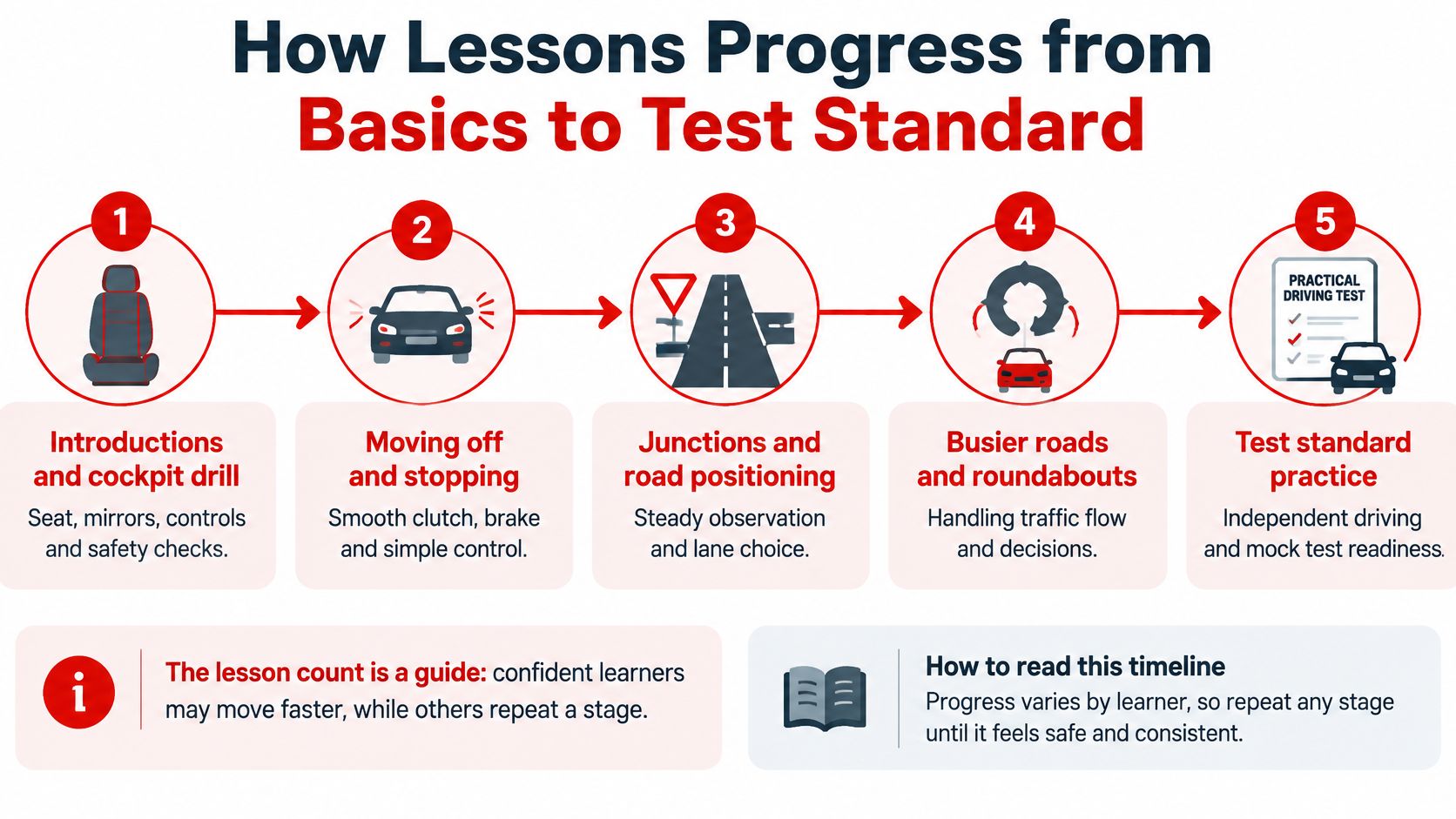
Build control before adding pressure
Controls and moving off come first because you need enough spare attention to notice what's outside. The instructor looks for measured pedal use and steering without repeatedly rescuing the manoeuvre.
Steering, observation and stopping belong together. Before pulling up, you need to check behind, select a suitable place and brake progressively while keeping the car positioned safely. The readiness check is a controlled stop without a last-moment rush towards the kerb.
Junctions add decisions about other people. You'll learn where to position the car, where to look and when your view is too restricted to commit. Correct observation means using what you see to make a safe decision, not merely turning your head.
Roundabouts and busier roads require earlier planning. Read signs and lane markings on approach, reduce speed appropriately, and choose your position before entering. If you keep turning too late, the instructor should help you identify the exit sooner rather than tell you to steer faster.
Move towards independent decisions
A common sticking point is watching only the vehicle ahead. Look beyond it for brake lights, crossings, parked vehicles and changes in traffic flow, while continuing to monitor your immediate space.
Reversing and parking develop alongside road driving. Later lessons should include unfamiliar destinations and independent decisions, not just rehearsed test routes.
Useful demonstrations can support the explanation before you practise with an instructor.
Readiness means consistency: appropriate speed, purposeful mirror use and safe decisions with little prompting across different drives. A successful manoeuvre after several coached attempts isn't yet an independent skill.
Use the practical driving test guide to understand the assessment, then ask your instructor which parts you can already demonstrate reliably.
Choosing Between Manual and Automatic Lessons
Licence flexibility matters before you choose a car. A manual pass allows you to drive manual and automatic cars; an automatic pass restricts you to automatics, so moving to a manual later requires a separate test.
Think about the cars you're likely to use, your physical comfort and how much attention operating the vehicle takes away from observing the road. Don't choose purely because someone else found a particular transmission easy.
Manual and automatic lessons compared
| Factor | Manual | Automatic |
|---|---|---|
| Controls | Clutch, gears, steering and pedals | Steering, accelerator and brake |
| Hill starts | Clutch and handbrake coordination needed | No clutch to manage |
| Licence after passing | Allows driving manual and automatic cars | Automatic cars only; a manual needs a separate test |
| Early lesson workload | Higher, with more to coordinate | Lower, so more attention for hazards |
In a manual, you learn to coordinate the clutch with the accelerator and select a suitable gear. On hills, that coordination becomes more noticeable because the car may roll if you release the brake before you're ready.
An automatic removes clutch operation and manual gear selection from the task. It doesn't remove the need for careful braking, speed judgement or observation, and you still need to understand how that particular car behaves on a slope.
Choose for your likely driving life
- Choose manual for flexibility. It can suit you if you expect to borrow family cars, share vehicles, or want a wider choice when hiring abroad. Check the actual vehicle you'll need rather than assuming all hire cars are manual.
- Choose automatic to reduce control workload. It may suit you if coordinating the clutch distracts you from traffic, or if you do not expect to need a manual.
- Consider physical needs early. Tell the school about pain, restricted movement, or adaptations before booking so they can discuss a suitable vehicle and instructor.
Ask which current models are available rather than relying on photographs of an older fleet. Seat adjustment, pedal position and visibility can matter as much as the transmission.
If you're undecided, arrange introductory experience in each type. Compare how much attention you have left for the road, not just whether you stalled.
What Lessons Cost and How Many You Need
A useful budget starts with the hourly rate, then allows for the paid lesson hours you need. In 2025, 50.3% of UK-approved driving instructors surveyed charged £36–£40 for a standard one-hour lesson, according to the Driver and Vehicle Standards Agency instructor survey. Treat that as a reference band, not a quote for your postcode, transmission or lesson time. Your instructor can assess your starting point and learning needs before you estimate the total.
Lesson options and what they include
| Option | What it includes |
|---|---|
| Standard one-hour lesson | Dual-control car and a qualified instructor |
| Block of 10 lessons | May offer a lower hourly rate; check expiry and terms |
| Intensive course | Several lessons over consecutive days; check availability |
| Test-day lesson | Pre-test refresher; confirm whether the test car is included |
A block booking can make budgeting easier if you can use the lessons within the stated terms. An intensive course concentrates practice into consecutive days, but the pace may not suit every learner, and a test may not be available immediately afterwards. Compare Lendrum's driving lesson packages by what they include, not only by the upfront payment.
Build a usable budget
Keep tuition separate from theory and practical test fees, test-day car use and any supervised-practice expenses. Check current government test fees before paying, rather than relying on an old screenshot or a friend's booking.
Ask these questions before committing:
- Test-day arrangements: Is car use included, and how is the warm-up lesson charged?
- Cancellations: What notice is required, and what happens if the instructor cancels?
- Pickup: Does the quoted lesson include collection from your address?
- Block terms: Do unused lessons expire, and what is the refund policy?
- Teaching time: How are briefings, driving practice and the final review organised?
A cheaper hour may cost more overall if unclear teaching means you repeat the same problem. Choose a schedule you can sustain. Regular practice helps keep routines familiar during the wait for a test, while a purchase you cannot continue may leave gaps in your learning.
Calming Nerves Before and During Lessons
A junction with fast traffic can make you feel you must decide immediately. At a roundabout, you might worry about holding everyone up; after a stall, you may feel watched even when nobody is reacting.
Tell your instructor what happens physically and mentally. Saying that you grip the wheel, stop hearing instructions or rush the clutch gives them something specific to address.
The triggers and practical responses below can help you prepare for that conversation.
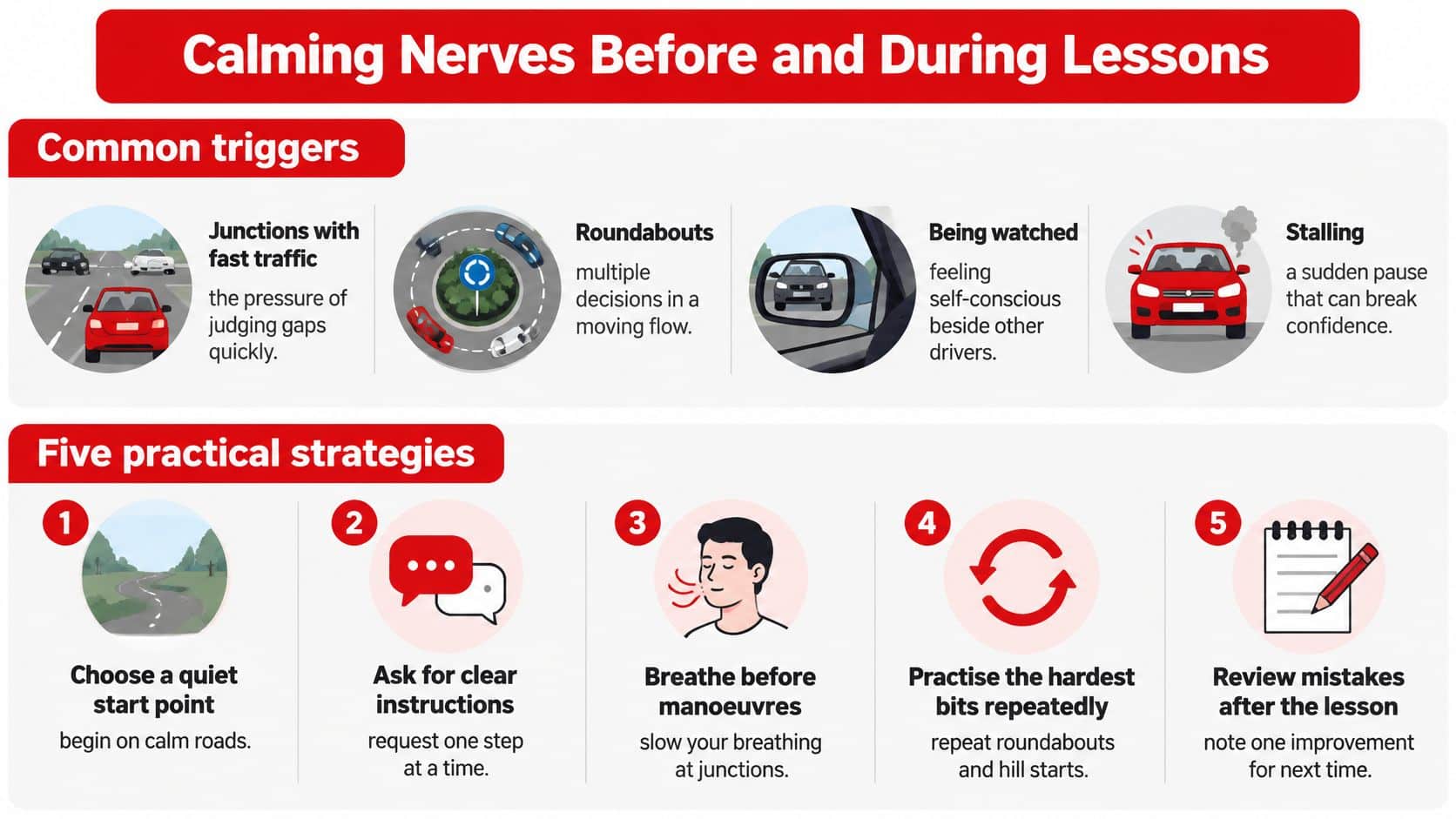
Make the task manageable
- Start somewhere quiet. Ask to begin on calm residential roads until you can listen and operate the controls without feeling overwhelmed.
- Agree a narrow goal. Write down a task such as approaching junctions without rushing. Request instructions early enough to act on them.
- Settle before moving. While safely parked, breathe gently and let the out-breath last a little longer than the in-breath. Don't attempt distracting breathing exercises while negotiating traffic.
- Ask to reduce the pressure. If you're overloaded, say so. Your instructor can guide you to a safe stopping place and simplify the next attempt.
- Review the cause, not your character. Replace “I'm terrible at roundabouts” with “I approached too quickly to read the lane markings”.
Confidence grows from repeated, manageable successes, not from avoiding difficult roads.
That doesn't mean forcing yourself into a situation you can't yet manage. Practise a simpler version, then add complexity when you can complete the task calmly.
If anxiety remains high across lessons, review the pace, session length, instructor relationship and transmission choice. The guide to overcoming driving anxiety offers further techniques to discuss with your instructor; persistent anxiety that affects everyday life may also warrant support from a health professional.
Keeping Skills Sharp While You Wait for a Test
The average wait for a practical car test in Great Britain reached 22 weeks in September 2025, according to the National Audit Office investigation summary. That makes maintaining competence a separate part of learning, rather than an afterthought.
A long gap can leave you hesitant with observations or inconsistent when reversing. You don't necessarily need to repeat your original lesson schedule, but you do need a maintenance plan.
Keep that plan alongside your booking information and practice notes.
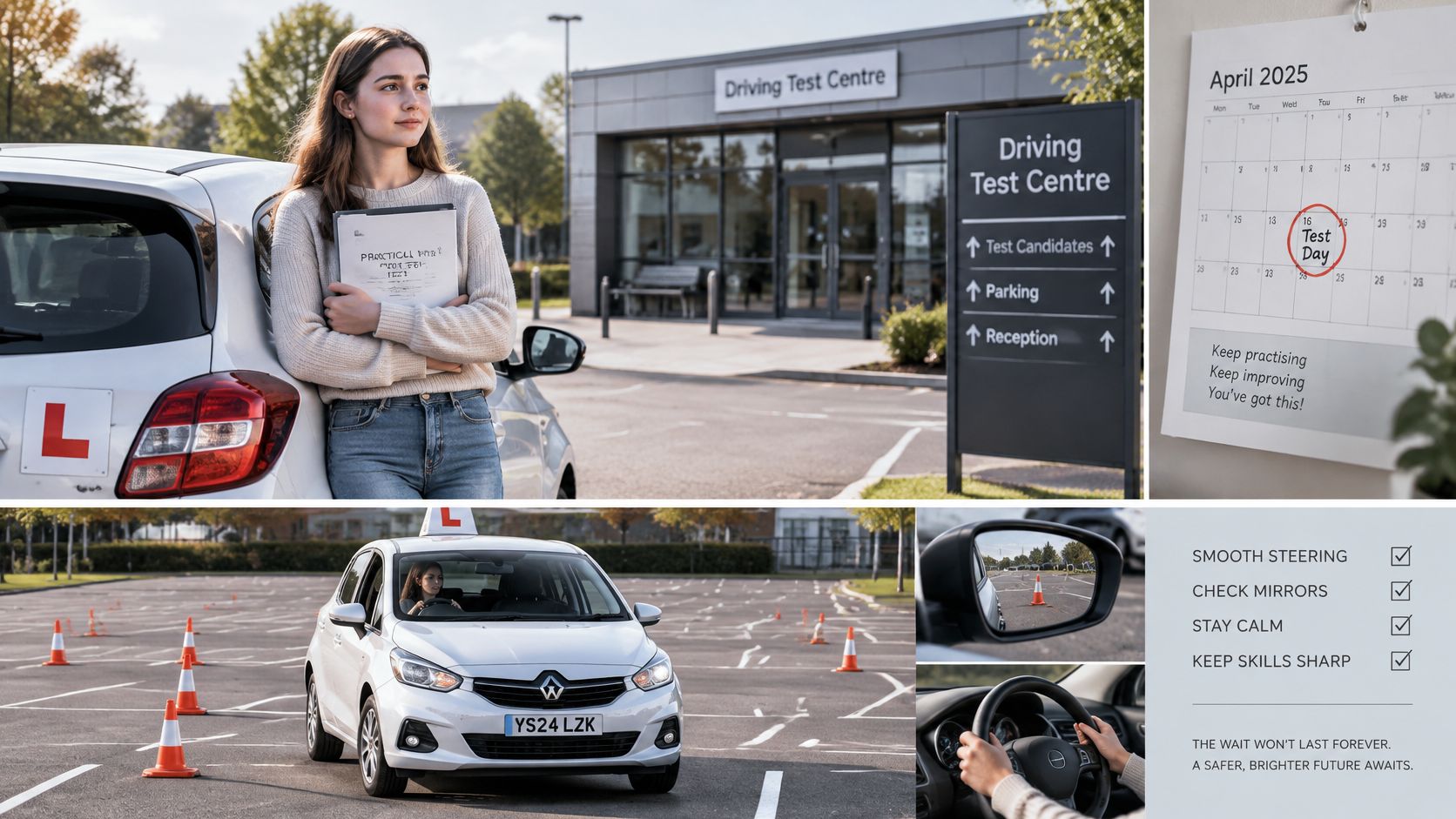
Use a staged maintenance plan
- Assess your present standard. Ask the instructor to distinguish reliable skills from tasks that still require help.
- Target the weak points. Practise the situations that expose uncertainty, such as emerging with a restricted view.
- Arrange suitable supervised practice. Confirm the supervisor, insurance and vehicle meet learner-driving requirements. Follow the instructor's agreed practice tasks.
- Reassess periodically. Agree a review every few weeks as a starting plan, then adjust the spacing to your performance and budget.
- Prepare close to the test. Use a refresher to check current ability, vehicle familiarity and practical arrangements.
During supervised practice, focus on junction observation, roundabout lane choice, purposeful mirror checks, hazard anticipation and controlled stopping. Discuss mistakes once safely parked, rather than turning a busy junction into a running debate.
Booking before your core skills are stable can encourage rushed tuition and unsuitable test attempts. Agree readiness with your instructor while allowing for local availability; don't treat the earliest available date as a deadline you must meet.
Repeatedly driving a familiar test route can conceal weaknesses. Include unfamiliar roads so you practise reading situations rather than remembering instructions.
Driving Alone After You Pass
In Great Britain, drivers aged 17–24 represented about 6% of licence holders in 2024 but were involved in 24% of fatal and serious collisions, according to the government's younger and older car drivers factsheet. That finding concerns younger drivers specifically, but planning unfamiliar driving situations is sensible at any age.
Test-ready isn't the same as experienced in every environment. A pass confirms the assessed standard, not mastery of all weather, road types and distractions.
Expand your experience deliberately
- Familiar daytime journeys: Begin with routes you know. Look for calm junction observations and unhurried parking before adding complexity.
- Unfamiliar destinations: Set the satnav before moving. Readiness means following signs and choosing lanes safely, even if you miss a turn.
- Rain and low sun: Choose manageable conditions, not severe weather. Check that you can maintain visibility, adjust speed and leave adequate space.
- Passengers: Start with someone calm who won't distract you. You should be able to pause conversation whenever driving needs your attention.
- Night driving: Begin on familiar, quieter roads. Check that you can judge bends, use lights correctly and respond safely to glare.
- Motorways: Arrange focused instruction before attempting an unfamiliar motorway journey alone. Practise joining, lane changes, following distances and exits with professional guidance.
These aren't boxes to tick in a hurry. Move on when your decisions are controlled and repeatable without another person prompting you.
If you avoid a situation, feel unsafe after repeated attempts or experience near misses, book tuition focused on that skill. Passing starts a new stage of learning; it doesn't end your need for feedback.
Book Your First Lesson With a Clear Plan
Before paying, agree on a practical starting arrangement. You can begin useful lessons without knowing your test date.
- Check your documents and eyesight. Have your provisional licence ready and raise any concerns before the appointment.
- Choose your transmission. Consider the type of car you expect to drive and how you prefer to learn.
- Set an affordable schedule. Choose regular lessons or an intensive format that fits your budget and availability.
- Agree a review point. Ask how your progress will be reviewed, whether you can have a learning plan, and what the pricing terms are.
Check the school's service area, lesson times and pickup options before booking. After your first few lessons, review your progress and decide whether to continue with the same schedule or adjust it.
Lendrum's Driving School offers manual and automatic beginner lessons, alongside motorway tuition and post-test training. Visit Lendrum's Driving School to check local availability and discuss a plan for your first lesson, test preparation and transition to driving alone.
Book a lesson today
Book NowReady to pass your driving test with friendly, professional tuition and boost your confidence on the road? Book your lessons with Lendrum’s Driving School today and start your journey to becoming a safe, skilled driver.