

Driving Lessons Salisbury: Costs, Pickup and How to Book

What happens if you finish an intensive driving course but still have a long wait before your test? Choosing driving lessons in Salisbury means planning more than how quickly you can learn. You need tuition that fits your starting point, keeps you progressing towards an available test date, and prepares you for the roads you'll drive afterwards.
Table of Contents
- Driving Lessons in Salisbury at a Glance
- Choosing Lessons by Stage, from First Lesson to Post-Test
- Instructor Credentials Worth Checking
- Salisbury Roads and What Lessons Should Cover
- Timing Lessons Around Your Test Date
- How to Book Salisbury Lessons and Confirm Before You Pay
Driving Lessons in Salisbury at a Glance
Lendrum's Driving School lists Salisbury among its covered areas, alongside Andover, Winchester and Southampton. Its options include manual and automatic tuition, intensive courses, motorway lessons, Pass Plus, and ADI/PDI instructor training.
Local pickup and daytime, evening and weekend lessons are offered, but availability depends on the instructor and location. Coverage does not guarantee that every lesson type or time is available at every address, so check before planning around a test date.
Compare the lesson formats
Lesson types offered in Salisbury and who they suit
| Option | Best for | Format and charging unit to ask about |
|---|---|---|
| Manual lessons | Beginners and improvers learning clutch control and gears | Weekly sessions, duration agreed at booking; ask for the price per lesson or block |
| Automatic lessons | Learners who want to drive without operating a clutch | Weekly or intensive tuition; ask whether pricing is per lesson, block or course |
| Intensive course | Learners approaching a fixed test date who are ready for concentrated tuition | Extended sessions over consecutive days; ask for the full course price |
| Motorway lesson | Late-stage learners and newly qualified drivers seeking supported experience | A single session or short programme, subject to suitability; ask for the per-session price or programme total |
| Pass Plus | Newly qualified drivers wanting wider experience | Structured post-test course; ask for the full course price |
| ADI/PDI training and Standards Check preparation | Trainee instructors and instructors preparing for assessment | Instructor-focused sessions; ask whether tuition is priced per session or as a course |
Start with the school's driving lesson packages, then request a current written quotation for Salisbury. The charging unit matters: an hourly lesson, a block and a complete course cannot be compared fairly until you know what each includes.
Understand the price benchmark
In September 2024, 47.7% of UK-approved driving instructors charged £36–£40 for a one-hour driving lesson, according to the DVSA working-as-a-driving-instructor survey. This is a national reference point, not a Salisbury quotation or a promise of current prices.
Compare the lesson duration, payment terms and cancellation conditions, as well as the headline amount. Ask whether use of the instructor's car for the practical test costs extra. Motorway tuition may include travel to a suitable road before coaching starts, while an intensive package may include assessment or preparation. Request an itemised breakdown so you can see what is covered.
Before comparing prices: Ask for the current price and charging unit in writing. A course total and an hourly rate are different measures unless you know what each includes.
Choosing Lessons by Stage, from First Lesson to Post-Test
Learning to drive is like learning to swim: steady practice in a manageable environment comes before tackling open water. A nervous beginner, an experienced learner with a test booked, and a newly qualified driver need different kinds of support.
The progression below is a useful way to think about those changing needs.
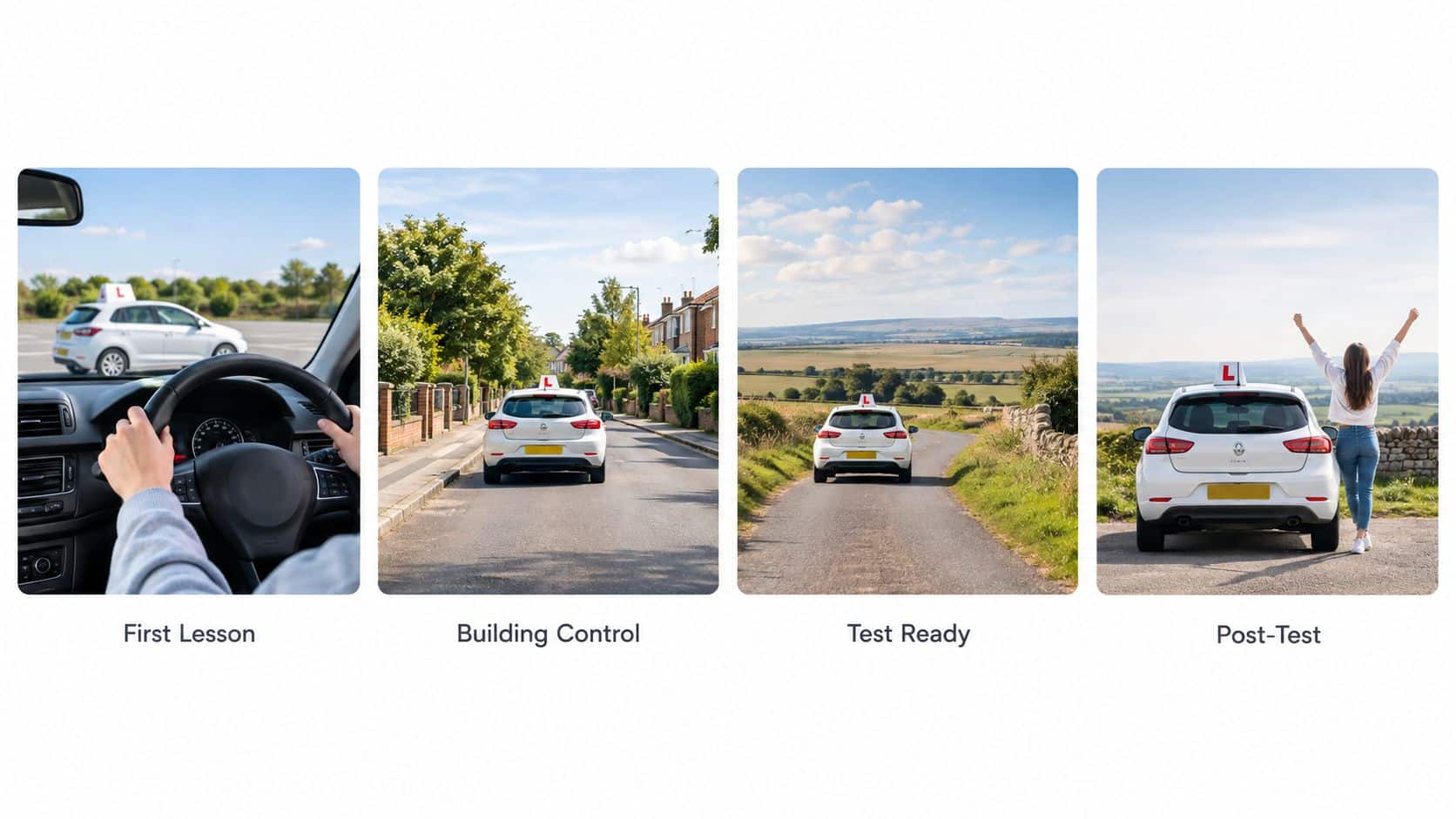
Begin with manageable goals
For a nervous beginner, a successful lesson doesn't have to mean reaching busy traffic. It might mean adjusting the seat correctly, understanding the pedals, moving away smoothly and stopping where intended.
Tell the instructor what makes you anxious. Fear of stalling calls for a different approach from difficulty processing instructions or worry about other drivers waiting behind you.
A useful lesson finishes with a clear explanation of what improved and what needs practice. Parents can help by asking what the learner understood, rather than treating distance travelled as the measure of progress.
Match the next step to the actual difficulty
A fixed test date doesn't automatically make an intensive course appropriate. If the learner already drives with limited prompting, concentrated tuition can help consolidate skills; if basic observation and control remain inconsistent, rushing adds pressure.
For a learner stuck on a particular task, narrow the lesson's focus:
- Hill starts: Practise coordinating the controls somewhere manageable before adding traffic pressure.
- Parallel parking: Break the task into observation, positioning, slow movement and correction.
- Changing to automatic: Use the reduced control workload to improve planning, rather than assuming the whole driving task is now easy.
Ask the learner to explain the task afterwards. Being able to describe why a decision was safe is more useful than remembering a sequence without understanding it.
Continue selectively after passing
In 2024, drivers aged 17–24 represented 6% of driving-licence holders but were involved in 24% of fatal and serious collisions in Great Britain, according to the government consultation on a minimum learning period.
That doesn't mean every young driver needs the same additional course. Pass Plus or targeted motorway tuition should address the driving the person expects to do.
Map regular journeys, passenger demands and confidence gaps before booking. Someone facing an unfamiliar commute may need different coaching from someone who mainly drives locally. Passing the test is an important achievement, but, like moving beyond the swimming pool, it's sensible to build unfamiliar experience gradually.
Instructor Credentials Worth Checking
Start by establishing the named instructor's ADI or PDI status. An Approved Driving Instructor is fully qualified; a Potential Driving Instructor is still training, so the descriptions aren't interchangeable.
Don't assume that a qualification mentioned on a school's website belongs to every instructor. Ask who will teach you and which credentials that individual holds.
What the different credentials mean
Instructor credentials and what each one signals
| Credential | What it signals | Who it helps most |
|---|---|---|
| ADI, Approved Driving Instructor | Full instructor qualification | Learners seeking a fully qualified instructor |
| PDI, Potential Driving Instructor | A trainee working towards full ADI qualification | Learners comfortable learning with a trainee whose teaching arrangements have been explained |
| ORDIT trainer status | Recognition connected with training driving instructors | Trainee instructors choosing a trainer |
| DIA Diamond Elite | An advanced driving credential associated with the Driving Instructors Association | Drivers interested in advanced driving development |
| ROSPA Gold | An advanced driving award from the Royal Society for the Prevention of Accidents | Drivers seeking stronger observation, planning and vehicle control |
| IAM Advanced Driver | An advanced driving qualification associated with the Institute of Advanced Motorists | Qualified drivers developing broader driving skills |
| Diploma in Driver Education | A teaching-focused qualification in driver education | Learners who value structured explanations and reflective learning |
Treat this as a guide to interpreting credentials, not confirmation that a particular Salisbury instructor holds them. Ask the school to verify individual qualifications before you book.
Extra awards can indicate specialist development, but they don't guarantee a pass or a teaching style that suits you. A learner who becomes overloaded by rapid instructions needs an instructor who can slow the explanation down and check understanding.
Assess the teaching as well as the qualifications
The school's guide to choosing a driving instructor can help you prepare your enquiry. Keep your questions specific:
- Individual qualifications: Which credentials does my named instructor hold, and how can I check them?
- Progress reviews: How will we record what I can do independently and what still needs prompting?
- Teaching approach: Can explanations, demonstrations and practice be adapted to how I learn?
A useful qualification tells you something about the instructor's preparation. A useful assessment lesson tells you whether you can learn comfortably together.
You don't need to commit to a large package before understanding that relationship. Ask what happens if the instructor, vehicle or teaching approach isn't suitable.
Salisbury Roads and What Lessons Should Cover
Salisbury learners need more than repeated practice on familiar urban streets. Training should prepare them to move between built-up junctions, village approaches, narrow rural lanes and higher-speed roads without carrying the same speed or expectations into every environment.
The wider traffic setting is substantial: the Department for Transport's Wiltshire road-traffic statistics report 3,850 million vehicle miles travelled on Wiltshire roads in 2025, including 2,975.2 million miles by cars and taxis. Those are county-wide figures, not measurements of Salisbury traffic alone.
Use the visual checklist to prompt a discussion about the conditions your lessons will cover.
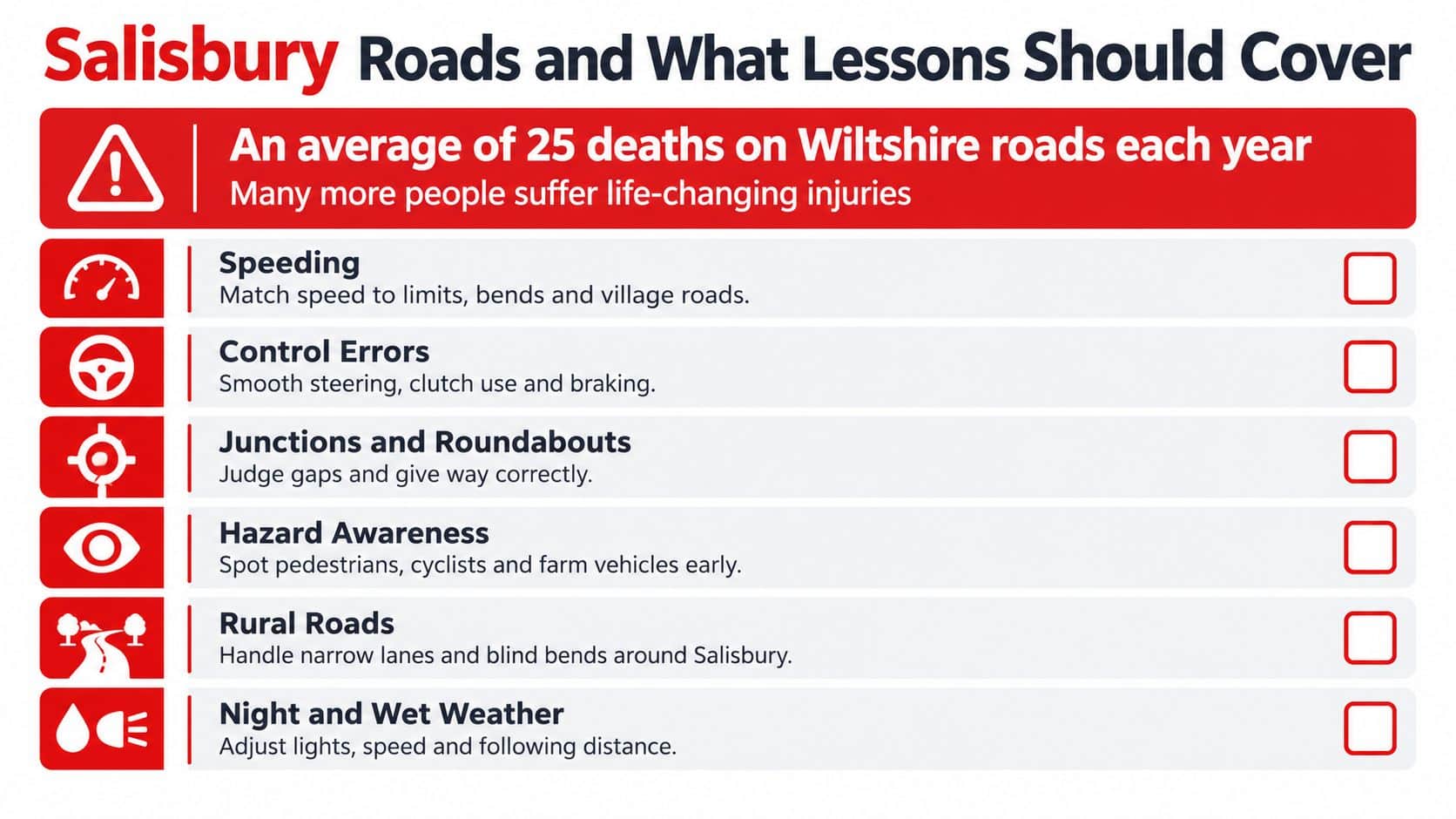
Read the road beyond the next bend
The Highway Code's guidance on driving techniques tells drivers to reduce speed approaching country-road bends and junctions because bends may be sharper and turnings partly hidden, while anticipating pedestrians, cyclists, horse riders, agricultural vehicles and mud.
The practical question is whether you can stop within the clear road you can see. On a narrow lane, you must also allow for someone approaching from the opposite direction.
Say a hedge hides the road beyond a bend. Ease off early, make any necessary gear change before turning, and avoid drifting towards the centre to improve your view.
Try a spoken coaching routine:
- Name the hazard: Describe the bend, hidden entrance or vulnerable road user.
- Assess the view: Identify where the visible clear road ends.
- Choose the speed: Slow before the hazard, leaving room to respond smoothly.
- Reassess afterwards: Check what has changed before accelerating.
Build varied practice into the route
A useful plan includes junction decisions, roundabouts, meeting traffic and transitions out of villages. The guide to choosing routes when learning to drive offers a starting point for discussing route variety.
Ask for practice that matches likely journeys:
- Glare: Practise using the visor and reducing speed when visibility deteriorates.
- Night driving: Arrange an appropriate session to work on lighting, judging bends and spotting less-visible road users.
- Wet conditions: Work on smooth braking and a larger safety margin.
- Unfamiliar journeys: Plan a route towards a nearby town, workplace or university destination, then practise following signs without abrupt decisions.
Use the video as a discussion prompt, not a substitute for coached practice.
Timing Lessons Around Your Test Date
The DVSA's driving-test appointment guidance reports a median wait of 11.1 weeks for tests taken in August 2026. That national indicator doesn't predict the next appointment available in Salisbury, but it shows why lesson planning and test booking need to work together.
The instinct to respond to a queue by booking the fastest course can be expensive. Compressed training followed by a long period without driving may leave you paying for refresher tuition before the test.
Choose a pattern you can sustain
Start lessons before you know an exact test date if you're ready to learn and can maintain a sensible routine. Use an assessment to establish your starting point before committing to a course or selecting an appointment.
Scheduling patterns against readiness and waiting time
| Plan | Lesson pattern | Best when | Main risk |
|---|---|---|---|
| Intensive | Extended daily sessions over a short period | The test date is fixed and readiness is already high | Skill fade if the test date moves |
| Semi-intensive | Several sessions across the week | The test is approaching and the learner has some experience | An unsettled date can disrupt the planned progression |
| Weekly | A regular lesson each week | The wait is long or the date is uncertain | Slower progress without suitable practice between lessons |
| Hold and refresh | Spaced maintenance sessions, followed by focused pre-test preparation | The learner is broadly ready but faces a long wait | Losing consistency without disciplined practice |
These are planning patterns, not promises about how quickly you'll qualify. Fatigue, confidence, previous experience and access to suitable practice all affect which pattern is sensible.
Readiness comes first: A cancellation is only useful if you're prepared for it and your instructor and test vehicle are available.
Maintain skills rather than repeatedly relearning them
During a long wait, give maintenance lessons a purpose. Ask the instructor to check independent decisions, unfamiliar routes and any habits that have slipped during private practice.
Where suitable supervised practice is available, agree what to practise and how the accompanying driver should respond. Contradictory instructions can leave a learner trying to satisfy different people rather than applying a consistent method.
If an earlier test appears, check the practical arrangements before changing your booking. Consider whether you can complete a fresh assessment, whether the instructor can attend, and whether the new date leaves enough preparation time.
Use pass rates carefully
The DVSA's car-driving-test datasets publish centre-level results, including overall outcomes and first-attempt breakdowns. Check the same reporting period and test category when comparing Salisbury with another centre.
A centre's pass rate isn't your personal chance of passing. It doesn't tell you whether you can manage unfamiliar junctions, recover calmly from a mistake or drive without help.
Build your budget around preparation and possible reassessment, not merely reaching a booked date. Readiness, confidence and available practice should decide the tuition pattern, rather than the speed advertised.
How to Book Salisbury Lessons and Confirm Before You Pay
A useful booking enquiry gives the school enough information to recommend an instructor and gives you enough detail to decide whether to pay. Have your pickup area, availability, transmission preference and previous experience ready.
Use this booking overview as a reminder, then work through the details with the school.
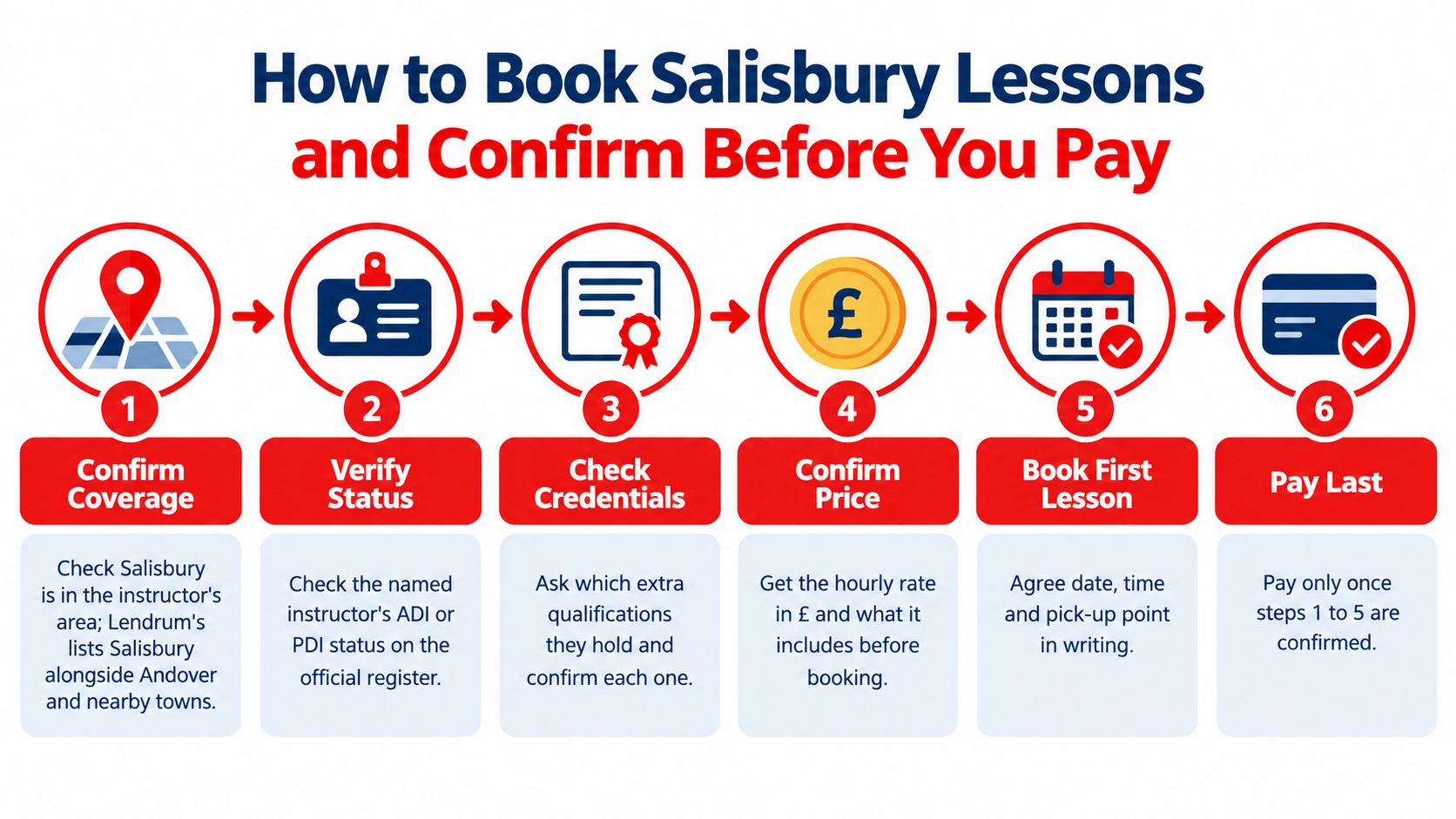
Set up the lesson properly
Confirm the actual pickup area. Give your postcode and intended starting address, not just Salisbury. Ask whether an instructor currently serves that location and whether there's a waiting list for your preferred times.
Identify who will teach you. Request the instructor's name and confirmation of their status. If you're seeking specialist tuition, such as instructor training or advanced driving, ask about the qualifications relevant to that work.
Choose the transmission and confirm the car. Explain whether you want manual or automatic tuition and whether you've driven before. Ask which vehicle you'll use in practice rather than choosing on the assumption that a particular model is available.
The wider fleet includes models such as the Mini Cooper, Ford Fiesta Eco, Citroën C3/C4, Škoda Fabia, Volkswagen Golf and Vauxhall Astra. Automatic options include Mini, Hyundai i10/i20 and Golf models, but the allocated instructor determines local availability.
Agree how pickup works. Specify home, school, college or work, and confirm whether the finishing address can differ. Ask how travelling to a suitable practice area affects the lesson and what happens if you're late.
Reserve a realistic time slot. Ask about day, evening or weekend availability, then choose a slot you can attend consistently. A lesson immediately after a demanding shift may be less productive than one when you're rested.
Agree the assessment and payment terms
Make the initial booking an assessment. Tell the instructor about any test booking, previous tuition and specific worries. Ask them to recommend goals and a suitable lesson pattern after seeing you drive.
Get the price and conditions in writing. Request the lesson duration, payment method, cancellation terms, refund arrangements and any separate test-day charges. Ask whether student or NHS discounts, or gift vouchers, are currently available and what restrictions apply.
Set a review point. Agree when you'll discuss progress, confidence and whether the lesson pattern still suits you. If you're buying a block, establish how unused credit is handled before paying.
Don't treat a fleet list, discount mention or advertised pickup service as a personal booking confirmation. The written agreement should identify what you're purchasing and who will provide it.
Before payment, check that you have clear answers on coverage, the named instructor, the lesson format, scheduling, pickup and total cost. If something remains unclear, ask for clarification rather than filling in the gap yourself.
Your next action is straightforward: request a first assessment lesson, giving your pickup postcode, availability, preferred transmission and any existing test arrangements.
Lendrum's offers manual and automatic tuition, intensive courses and post-test training, with Salisbury among its listed coverage areas. Visit Lendrum's Driving School to request an assessment lesson and confirm the instructor, pickup arrangements and current price before committing to a package.
Book a lesson today
Book NowReady to pass your driving test with friendly, professional tuition and boost your confidence on the road? Book your lessons with Lendrum’s Driving School today and start your journey to becoming a safe, skilled driver.