
Two Way Traffic Crosses a Two Way Road: UK Priority Guide
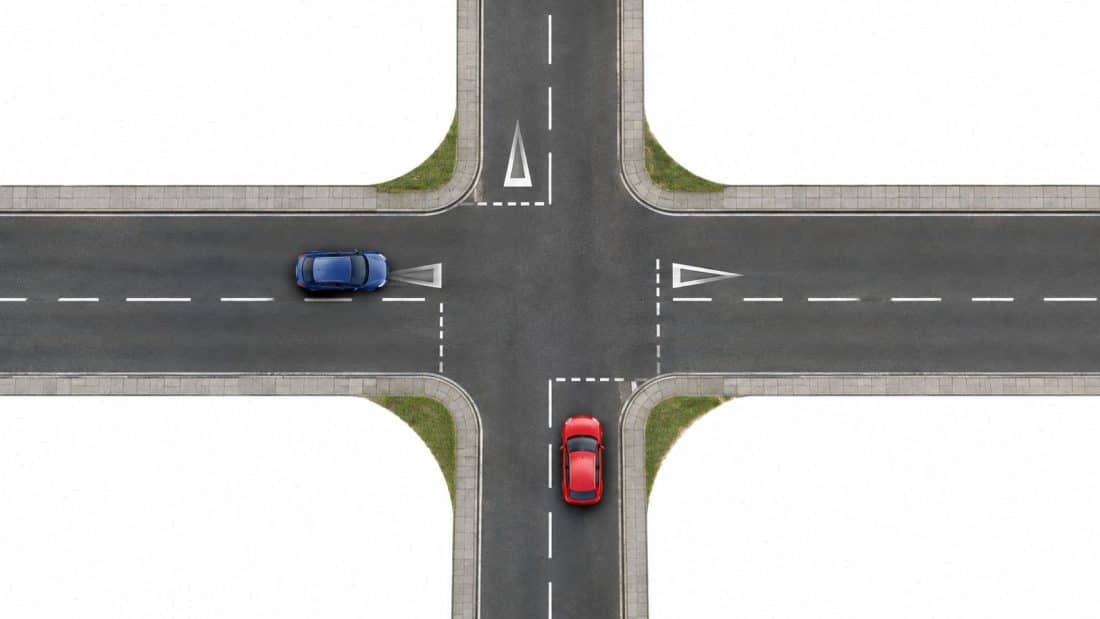
You're at a junction, the car in front has stopped, parked vehicles narrow your view, and traffic is coming from both directions. That's the moment many learners hesitate, not because they don't care, but because the usual advice sounds too simple for what they see in front of them.
The safer way to think about two way traffic crosses a two way road is as a decision sequence, not a slogan. Once you understand who controls the junction, who is already committed, and what each lane is doing, the confusion starts to clear. For a learner who keeps freezing at crossroads, this kind of step-by-step thinking is often the difference between guessing and driving calmly, and this guide on crossroad confusion shows how common that hesitation is.
Table of Contents
- Why Two Way Traffic Meeting a Two Way Road Feels Confusing
- Understanding What Two Way Traffic Crossing a Two Way Road Really Means
- Highway Code Rules That Govern Priority
- Junction Types and How Priority Changes Between Them
- Real Scenarios Where Two Way Traffic Meets a Two Way Road
- Common Misconceptions About Right of Way in the UK
- A Junction Routine You Can Use on Every Lesson
- Putting It All Together on Real UK Roads
Why Two Way Traffic Meeting a Two Way Road Feels Confusing
A learner often feels the uncertainty the moment vehicles approach from both directions at once. One car in view is rarely the whole picture. You have to read the near lane, the far lane, and decide whether anyone has already entered the junction.
That pressure rises at an uncontrolled crossroads. There may be no signs, no stop line, and no simple clue about which stream should move first. If another driver is already committed, your own choice changes at once. Parked vehicles can also hide part of the view, so the road may look clearer than it really is.
Why your brain hesitates
At the edge of the road, many learners try to solve the whole junction in one glance. That rarely works, because a two-way road presents two separate traffic streams, and both must be checked before you move.
Slow down enough to read the road, then decide. A rushed guess is usually the mistake that causes the collision.
The calm sequence an instructor uses in the car is there for a reason. Start by identifying the type of junction, then judge the traffic that has to be crossed. That is how you replace guesswork with a clear decision.
The same logic helps on ordinary roads too. Once a junction brings traffic from both directions into play, you have to weigh visibility, commitment, and turning paths together. If that still feels hard to picture, the hesitation is common enough that this guide on crossroad confusion addresses it directly.
Understanding What Two Way Traffic Crossing a Two Way Road Really Means
A two-way road carries traffic in both directions, usually one stream in each lane or carriageway. When people say two way traffic crosses a two way road, they're usually talking about a junction where one road meets another road carrying traffic both ways, not a pedestrian crossing.
That distinction matters because the conflict is between vehicles, but pedestrians can still change priority. The UK Highway Code says pedestrians crossing a two-way road should stop back from the kerb, look in all directions, listen, and cross in a straight line while continuing to look and listen Highway Code rules for pedestrians.
The road shapes you need to picture
A crossroads is where two roads meet and each road may carry traffic in both directions. A T-junction has one road ending into another, so the main conflict is usually between traffic on the through road and traffic joining or turning across it. A staggered junction is really two separate junctions offset from each other, even if it looks like a crossroads at first glance.
The phrase committed vehicle is useful here. It means a vehicle that has already started the move into or across the junction, so its presence changes what's safe for everyone else. If a car is halfway through a turn, you don't treat the junction as empty just because no one else has reached the centre yet.
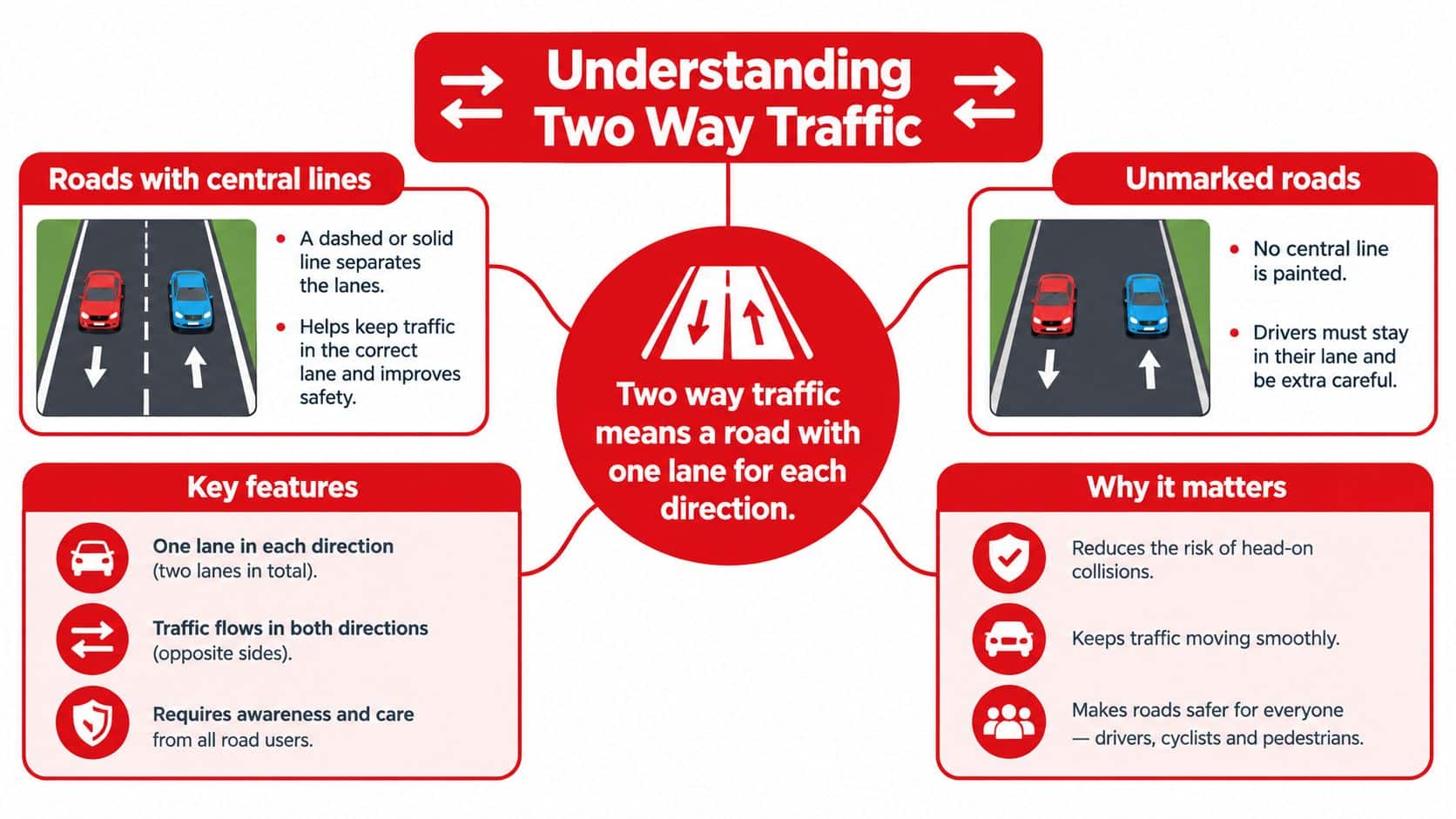
Think of it this way. The layout tells you which paths can conflict, and the traffic tells you which path can move first. If you can point to the conflicting streams, you're already ahead of the average learner.
Highway Code Rules That Govern Priority
The UK Highway Code doesn't give a blanket rule that works at every junction. It gives you a set of rules that apply depending on the movement, the signs, and whether pedestrians are already crossing or waiting to cross.
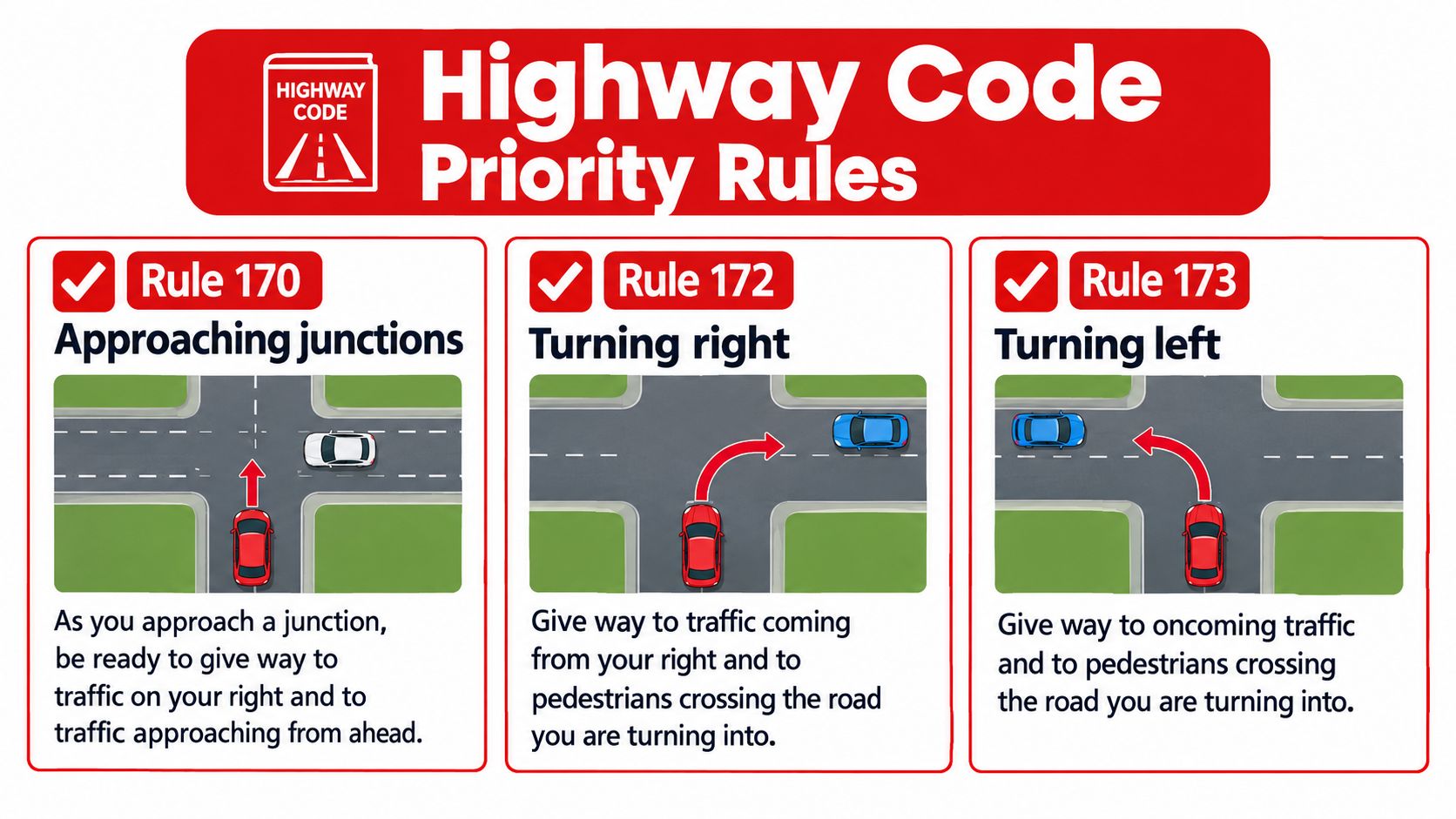
Rule 170 tells drivers to approach junctions with care and to look out for pedestrians, cyclists, and other road users. Rule 172 covers turning right, including checking for traffic coming the other way and waiting for a safe gap. Rule 173 covers turning left, which still needs care because pedestrians may be crossing the road you're entering. The pedestrian rules in Rules 1 to 9 matter too, because on a two-way road, people crossing can affect your timing even when you think the road is clear Traffic controls and junction rules for new drivers.
Signs and markings that change the default
A give-way line and triangle sign tell you to yield to traffic on the road you're joining. A stop sign requires a full stop before proceeding when safe. Double white lines and yellow box junctions can also change what you're allowed to do, especially where traffic flows are tight or visibility is limited.
The absence of a sign doesn't create automatic priority. It just means you fall back on the actual road layout, the other road users present, and the safety judgement required by the junction.
Legal priority and defensive priority are not the same thing. You can be right and still wait.
That's why a cautious move can be the correct move even when another driver ought to give way. If the other driver hasn't slowed, hasn't committed, or hasn't seen you, relying on your theoretical right won't protect you.
Junction Types and How Priority Changes Between Them
The junction shape decides how you read priority. That's why a driver who learns one simple rule and applies it everywhere usually gets into trouble, because a crossroads, a T-junction, a staggered junction, and a roundabout all create different conflict patterns.
How the main layouts differ
At an uncontrolled crossroads, there may be no markings at all, so you judge the gap, the visibility, and whether another vehicle is already committed. At a T-junction, the road ending into the main road usually has to give way, so the learner focuses on the traffic flow on the through road. At a staggered junction, the move is split into two separate decisions, not one. At a roundabout, traffic already on the circle has priority, and the vehicle joins only when there's a safe gap.
| Junction type | Priority cue | Common conflict | Learner action |
|---|---|---|---|
| Uncontrolled crossroads | Visibility and commitment | Two vehicles arriving together | Slow early, read both roads, wait if unclear |
| T-junction | Give-way or stop controls | Joining traffic crossing the main road | Check both directions, then move only when clear |
| Staggered junction | Two separate junctions | Treating it like one crossing | Deal with each side separately |
| Roundabout | Traffic already circulating | Entering against a moving stream | Approach prepared to yield, then join at a safe gap |
The point of this comparison is simple. Junction shape changes the risk, so the driver's job changes with it.
For a learner, roundabout practice guidance is useful because it reinforces that you don't force a move just because you've arrived first. You wait for a gap that actually exists, not one you hope will appear.
Real Scenarios Where Two Way Traffic Meets a Two Way Road
A quiet residential crossroads can still catch a learner out when parked cars block part of the view. You inch forward only until the sightlines improve, because going too far can put the front of the car into traffic you still have not seen. The right question is broader than “can I see one car?”, ask whether the full junction has been checked properly.
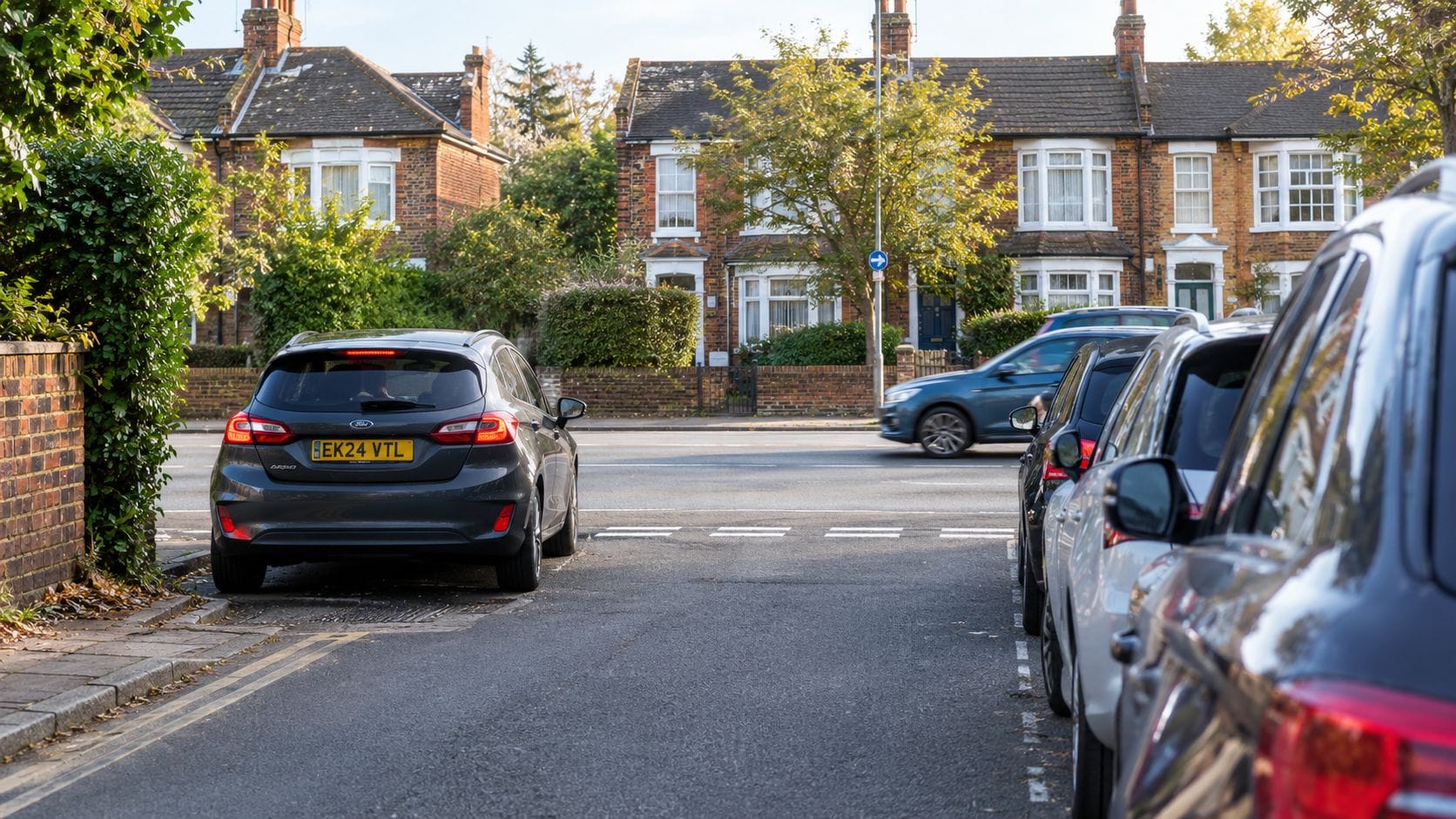
A right turn across oncoming traffic at a busy junction needs the same discipline. A driver opposite may flash headlights, but that flash does not hand over priority and it does not confirm the lane is clear. It may be a warning, a courtesy, or a mistake, so the safe habit is to read the whole gap yourself.
Pedestrian crossings add a different kind of check. The UK rules say drivers must give way to pedestrians waiting to cross or already on the crossing, and at a zebra crossing they must stop at the broken give-way line, about 1 metre before the crossing, not in the zig-zag markings Pedestrian, cycle and equestrian crossings. Great Britain's 2025 casualty figures show why that caution matters, with 364 pedestrians killed and 5,958 seriously injured, plus 98 deaths and 2,235 killed-or-seriously-injured casualties recorded at or within 50 metres of a pedestrian crossing facility pedestrian factsheet 2025.
Each scene follows the same logic. Read the layout, check the traffic, see whether anyone is already committed, then move only when the crossing is genuinely safe, not just when the nearest lane looks open.
Common Misconceptions About Right of Way in the UK
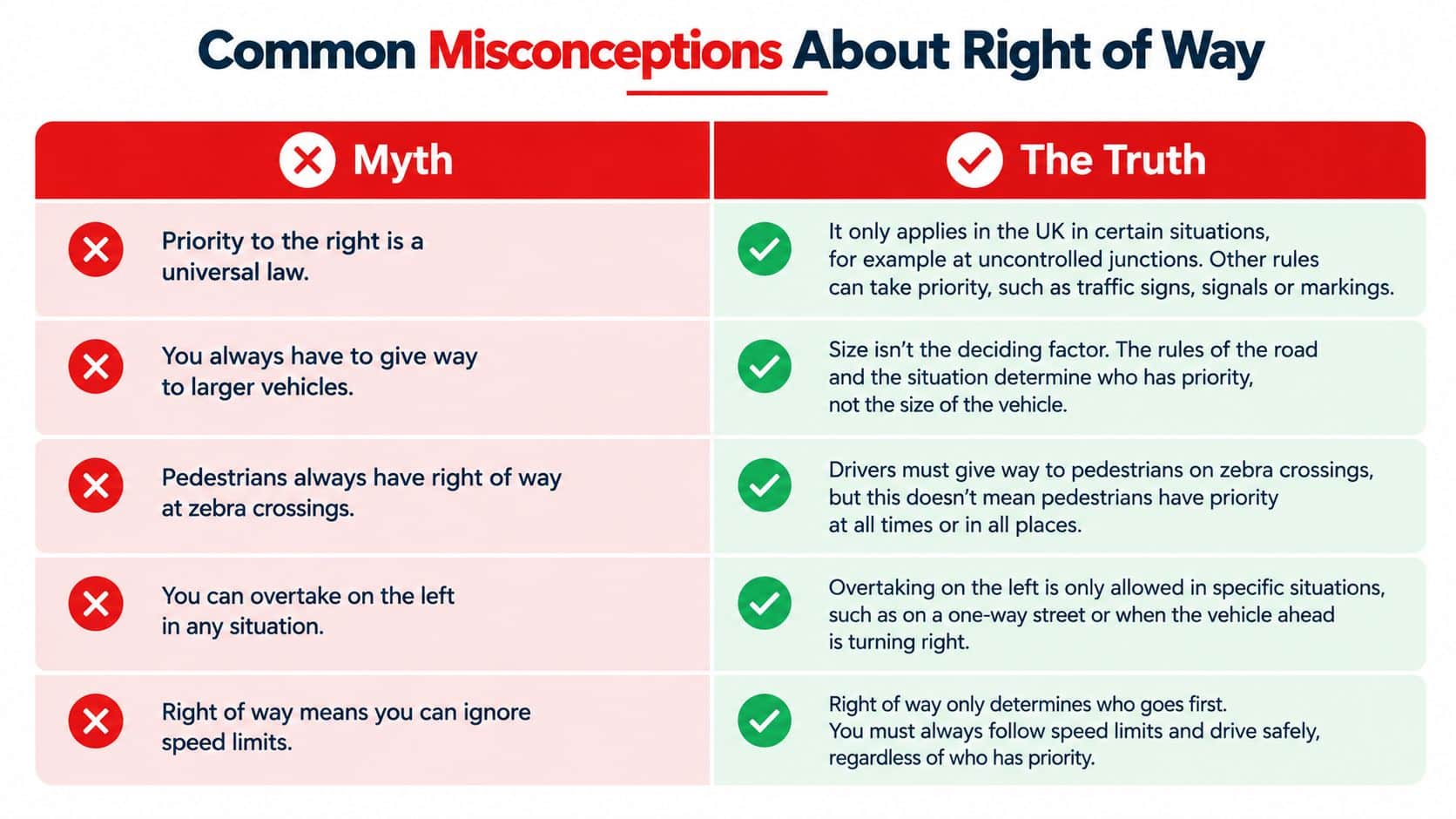
One of the biggest myths is that the UK has a universal priority to the right rule. It doesn't on public roads, and treating every junction that way can lead you straight into conflict where signs, markings, or road layout say something else.
The myths that trip learners up
- “Flashing headlights mean I can go.” They don't. A flash is not permission, and it's not a legal handover of priority.
- “The biggest vehicle wins.” Size doesn't create priority. A large vehicle still has to obey the same rules as a small one.
- “Whoever gets there first goes first.” That only helps if the junction is clear and that vehicle has committed safely.
- “Pedestrians have right of way everywhere.” They don't. Their priority depends on where they are and which crossing or carriageway is in play.
- “Hesitation is dangerous.” Uncertainty is not the same as bad driving. Waiting at a doubtful gap is often the safer choice.
The better habit is to treat hesitation as information. If you're unsure, the junction isn't ready for you yet. That's not weakness, it's a sensible response to a road layout that hasn't given you enough certainty.
A Junction Routine You Can Use on Every Lesson
Use MSPSL, mirrors, signal, position, speed, look, then add four questions before you move. Those four questions are, who has priority here, who is already committed, what can I see, and what can't I see.
The routine in practice
Mirrors and signal tell you what your own car is doing before you judge the junction. Position and speed help you arrive in a place where you can see properly without drifting into danger. Look means checking both directions, not just the side that feels most obvious.
If you reach a crossroads with parked cars, the “what can't I see” question matters most. If you're turning right across traffic, “who is committed” matters most. If you're approaching a crossing, “who has priority here” matters most because pedestrians may already be on the move.
Ask the questions in the same order every time. Consistency stops panic from taking over.
For mirror awareness around junctions, T1A Auto's blind spot guide is a useful reminder that side views can hide more than you think, especially when traffic is close and moving quickly.
Putting It All Together on Real UK Roads
A learner approaching a junction can feel the pressure build fast. Two way traffic crosses a two way road as a judgement task, and the safest driver is the one who slows early, scans both directions, and watches for vehicles that have already committed.
The casualty figures covered earlier show that danger does not sit neatly at one kind of crossing. Read the whole road, not just the first gap that appears. A single glance is never enough.
If you want the logic to become natural, practise the MSPSL routine first on quiet residential junctions, then move to busier roads where the gaps are smaller and the views are harder. Ask your instructor to mark how well you identify controls, spot committed vehicles, and judge safe gaps, because those are the skills that make junctions feel manageable.
Lendrum's Driving School offers structured manual and automatic lessons, including junction practice and roundabout training that fit this topic directly. If you want calm, practical help with priority at two-way junctions, visit Lendrum's Driving School and book lessons that focus on real-road decision making.
Book a lesson today
Book NowReady to pass your driving test with friendly, professional tuition and boost your confidence on the road? Book your lessons with Lendrum’s Driving School today and start your journey to becoming a safe, skilled driver.