
Driving Test Cancellations App: Find an Earlier Slot
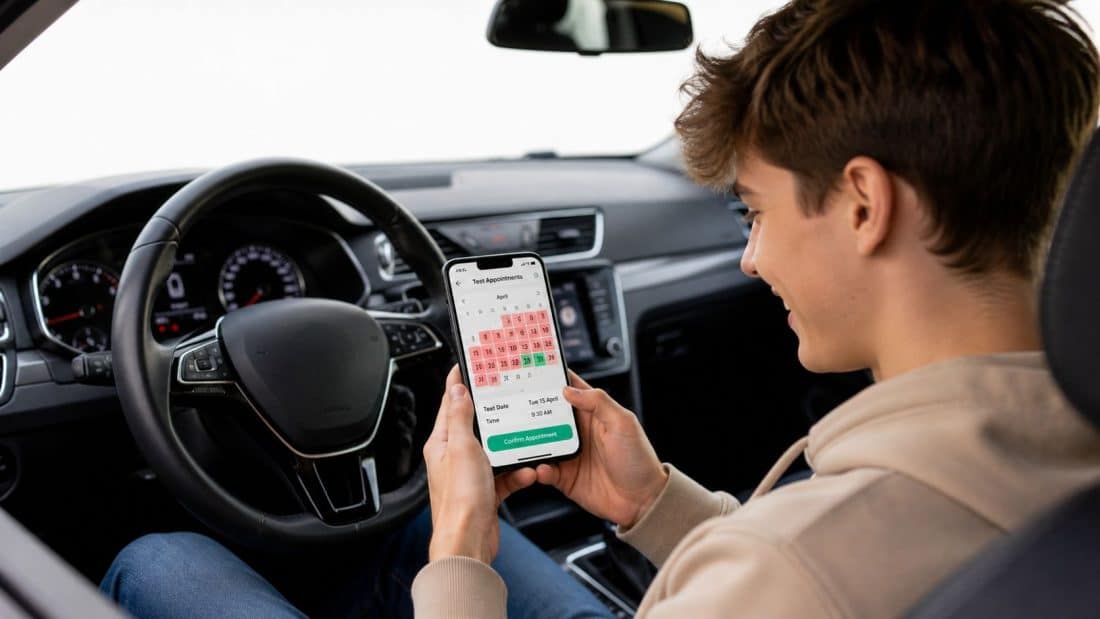
You're searching for a driving test cancellations app, but have you checked whether the app is allowed to do what its advert promises? An earlier test date can feel like the answer to every problem, especially when you're ready to drive and the booking system offers nothing useful. Yet an app that automatically searches, changes or secures your appointment can create a bigger problem than the original wait.
The safest approach in 2026 is clear. Use GOV.UK to control your booking, treat third-party tools with suspicion, and only accept an earlier test when you and your instructor can support it. A cancellation alert may be helpful, but it can't replace test-centre capacity, proper preparation or compliance with the latest DVSA rules.
Table of Contents
- The Frustration of the Driving Test Wait
- How the DVSA Booking System Actually Works
- The Legal Risks of Cancellation Apps
- Comparing App Alerts to Official Alternatives
- Local Considerations for Southampton and the South Coast
- A Safe Workflow for Using Cancellation Apps
- Why Intensive Courses Are the Real Solution
- Moving Forward with Confidence
The Frustration of the Driving Test Wait
You've passed your theory test, your instructor says your driving is close to the required standard, and then the practical test booking brings everything to a halt. You check GOV.UK on Monday morning, hoping a suitable appointment has appeared. Instead, you find distant centres, unsuitable times or a date so far away that your confidence starts to fade.
That frustration is not imagined. The National Audit Office investigation into car driving-test waiting times reported that the average wait for a car test in Great Britain reached 22 weeks in September 2025, compared with just over 5 weeks in February 2020. The same report estimated that COVID-19 restrictions caused approximately 1.1 million lost car practical tests between April 2020 and March 2021.

Why the wait feels personal
A learner in Southampton may feel ready for a test but find that the next useful appointment doesn't fit their instructor's availability. Someone in Portsmouth may see an earlier slot but lack access to a suitable training car. A learner in Winchester or Plymouth may find a date that looks attractive until travel time, unfamiliar roads and route practice are considered.
That's why a cancellation app looks so tempting. It promises to watch the system while you work, sleep or attend lessons. If an earlier slot appears, the alert may give you a chance to move your test forward.
The problem is that an alert is not the same as a booking, and an earlier date is not automatically a better date. The NAO found that the Driver and Vehicle Standards Agency provided 1.96 million driving tests in 2024–25 but lost 257,662 slots, representing 13% of the total, with learner cancellations accounting for 84,901 of those lost tests. Those figures show why cancellations exist, but they also show why they can't solve a shortage of appointments by themselves.
Practical rule: Never chase an earlier test faster than you can prepare for it.
How the DVSA Booking System Actually Works
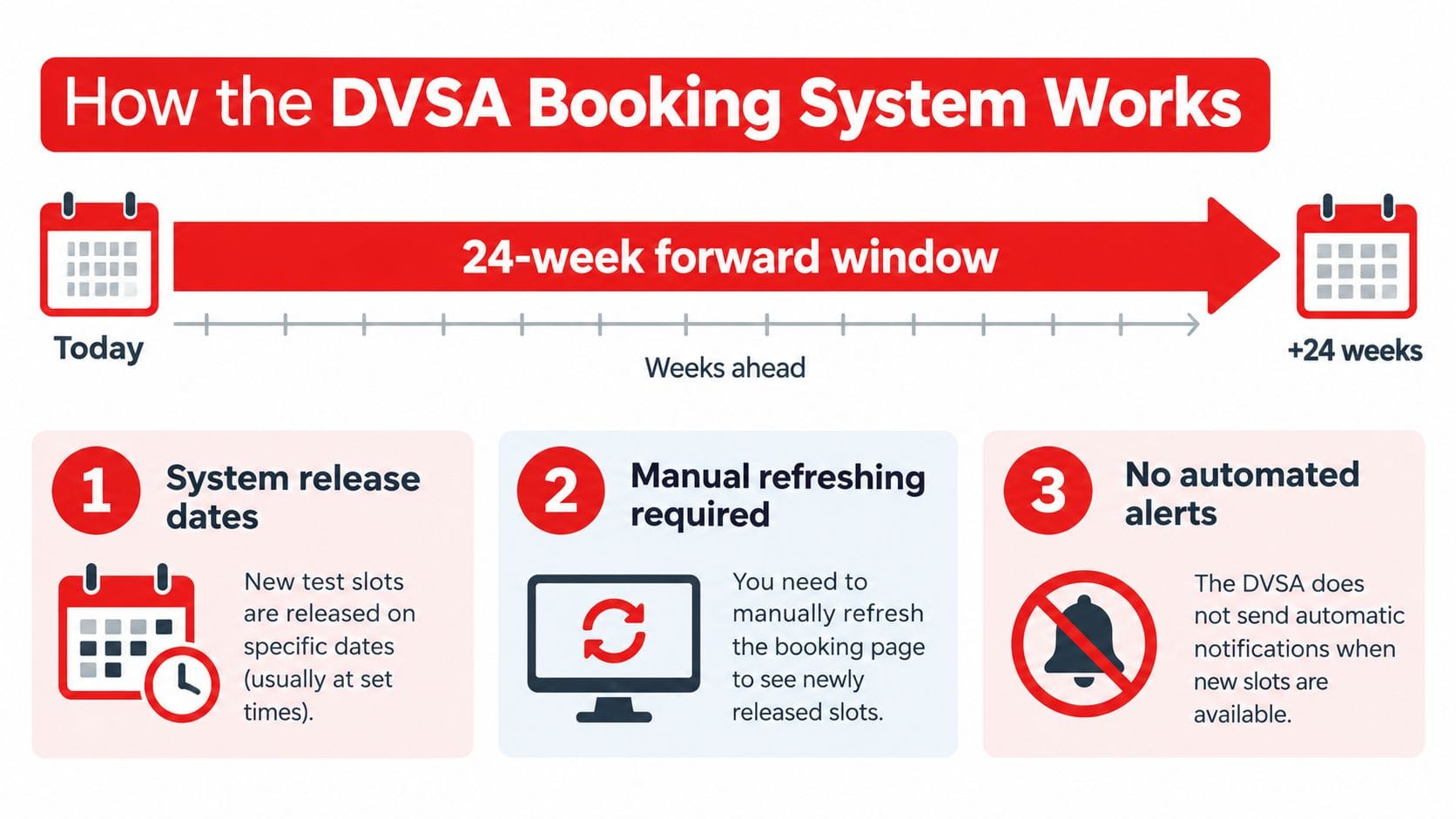
Before choosing a tool, understand the system it claims to monitor. The DVSA booking service uses a 24-week forward window. New car-test appointments are released every Monday at 06:00, while earlier appointments can appear at any time when another learner changes or cancels a booking. The official guidance is available through how to book or change a driving test on GOV.UK.
This creates two different patterns of availability. Monday's release is a scheduled event, but cancellations are unpredictable. A slot may appear in the middle of the day, disappear quickly and then reappear after another learner changes their selection. There's no official waiting list or cancellation list that sends you a guaranteed appointment.
What a responsible tool should do
A technically cautious notification service would record your selected test category, preferred centres and relevant manual or automatic requirements. It would avoid repeated, unauthorised access to the DVSA booking system, prevent duplicate alerts and leave the learner to complete the booking through GOV.UK.
That distinction matters. Appointment scheduling software can be useful in many ordinary business settings, and Recepta.ai scheduling automation provides useful background on how automated scheduling works more generally. A driving-test service is different because the DVSA controls access, applies specific terms and requires the learner to manage their own appointment under the current rules.
For practical guidance on the official process, read this guide to booking a driving test. The key lesson is simple: use the official service to see genuine availability, then check whether the slot works for your training plan before you change anything.
Why speed creates risk
An app may advertise frequent checking as its main advantage. That can sound attractive, but aggressive polling can trigger bot detection or access restrictions. Faster checking also doesn't guarantee that the slot will still be available when you open GOV.UK.
The sensible workflow is therefore not “let the app take over”. It is “receive information, verify it yourself and make the decision manually”. That approach may feel less exciting, but it protects your booking and keeps the final action in your hands.
The Legal Risks of Cancellation Apps
The common assumption that cancellation apps are harmless convenience tools is now unsafe. From 12 May 2026, only the learner taking the test can book and manage their practical-test appointment. Unofficial third-party booking and cancellation-finder services, as well as instructors, can't book, change, swap or cancel a test for someone else under the new rules set out in the DVSA announcement on unofficial driving-test booking services.
That doesn't mean every notification message is automatically the same as an agent changing your appointment. It does mean you must examine what the product does. An app that tells you a slot may be available is materially different from a service that logs into your account and completes the transaction for you.
The account consequences
The DVSA has warned that unofficial websites, apps and bots aren't approved and may breach the booking service's terms. It has also identified automated services repeatedly querying its systems and taken steps to block them. If the DVSA suspends your online booking access, you may be forced to use the telephone service instead.
That risk is unacceptable if you've already struggled to secure a suitable appointment. You could lose access at the exact point when you need to make a legitimate change, and an automated service won't be able to repair the damage on your behalf.
The DVSA guidance on the new rule for driving-test changes and cancellations also explains the importance of the 10-full-working-day deadline for changing or cancelling a car test without losing the fee. Treat that deadline as part of your decision process, not as an afterthought.
The two-change limit
Learners are limited to two appointment changes, a restriction introduced on 31 March 2026, according to the same DVSA guidance. Moving from Southampton to Portsmouth, then switching again because the time doesn't suit your instructor, can use both changes before you've taken the test.
The dangerous promise is not “we found a slot”. It's “we'll manage everything for you”.
Never provide your GOV.UK password, booking reference or personal details to a service that intends to act as you. If a product can't explain precisely whether it only sends notifications or attempts to make changes, don't use it.
Comparing App Alerts to Official Alternatives
A cancellation app offers convenience. The official DVSA service offers control. A driving school offers preparation and local judgement. Those are different functions, and treating them as interchangeable is how learners make poor decisions.
| Option | What it can offer | Main weakness |
|---|---|---|
| GOV.UK booking service | Direct access to official appointments and learner-controlled changes | You must check availability yourself |
| Notification-only tool | A prompt when a possible slot may have appeared | The alert may be late, incomplete or unusable |
| Automated booking service | Claims to search or change appointments on your behalf | It may breach DVSA terms and put your booking access at risk |
| Instructor support | Readiness advice, route knowledge and practical scheduling guidance | Your instructor can't manage the appointment for you under the current rules |
The official service should be your foundation. It's the only place where you can verify the appointment, confirm the centre and complete a permitted change yourself. An app can add convenience only if it stays outside that transaction.
The readiness test
Ask three questions before accepting any cancellation:
- Can you take the test at short notice? Your instructor and suitable vehicle must be available.
- Can you practise the centre's likely roads? A familiar town may be safer than a distant appointment.
- Would you still be ready if the test were moved forward immediately? If not, the date is not an opportunity yet.
A cancellation tool can't assess your mirrors, planning, independent driving or response to pressure. It can't tell you whether you're rushing because you're ready or because waiting has become exhausting.
The official process may take more effort, but it doesn't expose you to an unofficial intermediary. If you use an app, choose the narrowest possible role for it: information only, no credentials and no booking action.
Local Considerations for Southampton and the South Coast
A national availability picture doesn't tell you whether a particular slot is practical. Learners in Southampton, Portsmouth, Winchester and Plymouth need to consider the centre, the route, the instructor's diary and the training vehicle before treating an earlier appointment as useful.
Searching more than one eligible centre can make sense because DVSA availability is centre-specific and can change at any time. But a wider search only helps when you can genuinely attend the test. A slot in Portsmouth isn't a sensible alternative for a Southampton learner if there's no time to practise the roads or arrange the car.
The distance decision
Use this test before changing location:
- Training access: Can your instructor provide lessons in the alternative area?
- Vehicle access: Will the correct manual or automatic car be available?
- Route familiarity: Can you practise the relevant junctions, roundabouts and traffic conditions?
- Travel practicality: Can you reach the centre calmly and on time?
- Change allowance: Is this location worth using one of your two permitted appointment changes?
The answer may be “wait for Southampton”. That isn't failure. A nearby test with consistent practice can be a stronger choice than a sooner appointment that creates unfamiliarity and logistical stress.
A learner who lives near Winchester may also need to weigh local availability against instructor coverage. Someone in Plymouth may have different route and travel considerations from someone on the eastern side of the south coast. Don't copy another learner's cancellation strategy without checking whether the centre suits your circumstances.
For learners who need concentrated support in the area, intensive driving courses in Southampton can help organise training around a realistic test plan. The principle applies across the region: choose the centre your preparation can support, not just the first date an alert produces.
A Safe Workflow for Using Cancellation Apps
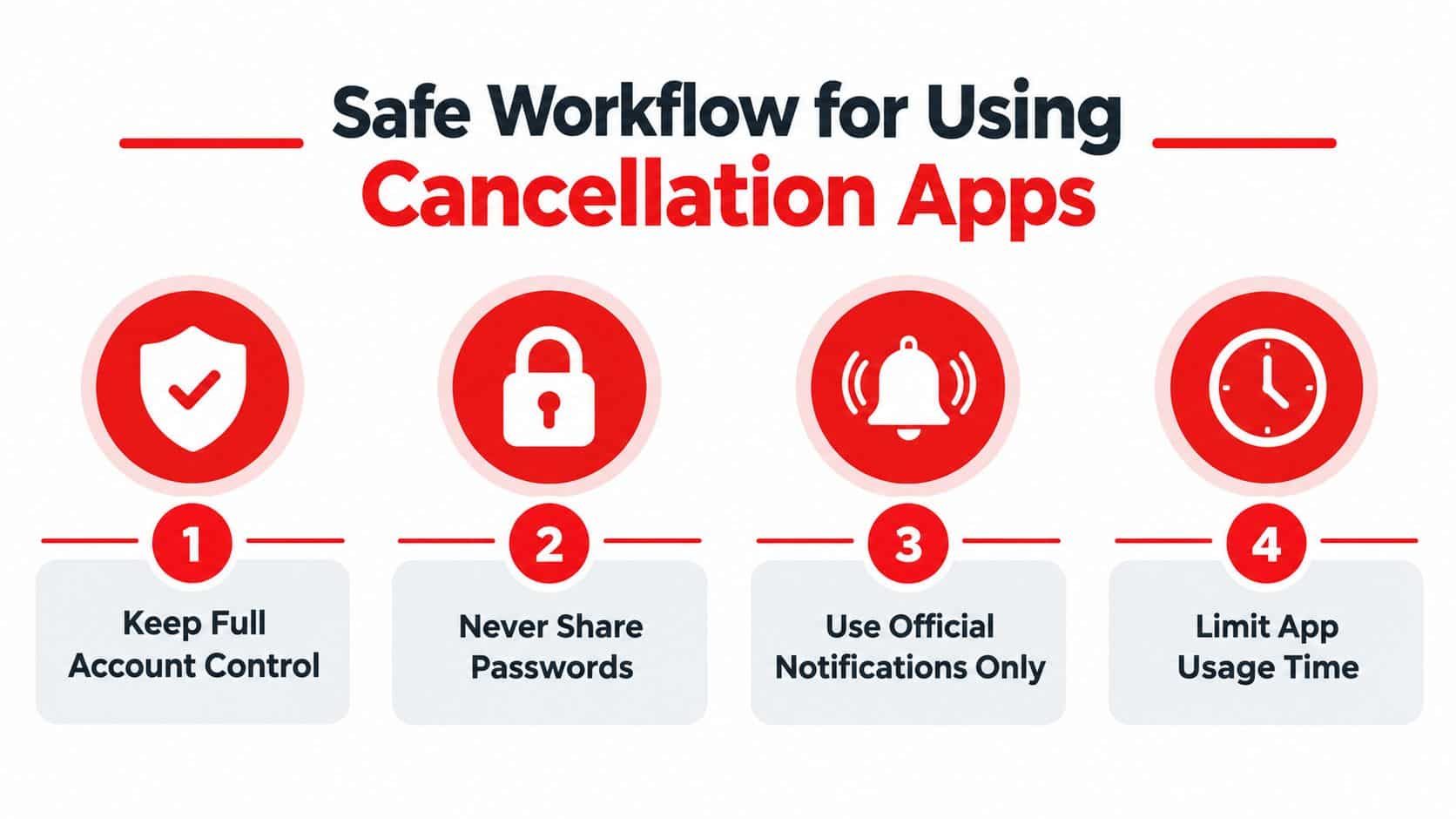
If you still want to use a cancellation app, restrict it to notification work. Don't let a third party take control of the account that determines your test date, fee and access to the booking service.
Follow this process
- Keep the GOV.UK account under your control. Sign in yourself and make every booking or permitted change personally.
- Never share passwords or login details. No legitimate convenience is worth handing over access to your appointment.
- Define acceptable centres in advance. Include only locations that you, your instructor and your vehicle can realistically support.
- Verify every alert independently. Open GOV.UK, check the appointment details and confirm that the slot is still present before making a decision.
- Check your remaining changes. Record whether you've already moved the date or centre, because impatience can consume both permitted changes.
- Stop using the service if it asks to act for you. A request for credentials, payment for guaranteed access or permission to book on your behalf is a clear warning sign.
The alert should be a prompt, not an instruction. You still need to check your readiness, travel arrangements and the notice period before changing anything.
If the app can make the change without you, it has gone beyond a safe reminder.
Keep your use limited and organised. Constant checking can make nervous learners more anxious, especially when every notification feels like a decision that must be made instantly. A calm manual verification step protects you from accepting a slot you can't use.
Why Intensive Courses Are the Real Solution
The best answer to a long wait isn't always a faster alert. Often, it's becoming ready enough to accept a suitable appointment when it appears. Learners who spend weeks chasing dates without improving their driving can end up with an earlier test but no realistic chance of passing.
An intensive course can concentrate tuition into a shorter, organised period. Instead of allowing skills to fade between widely spaced lessons, you work repeatedly on observation, planning, manoeuvres, independent driving and the specific weaknesses your instructor identifies. That structure can also help nervous learners replace vague worry with a clear list of tasks.
Preparation beats frantic booking
A well-planned intensive programme should answer practical questions:
- What still needs work? You should know which faults are occasional and which appear consistently.
- Can you handle unfamiliar conditions? A test centre change may expose gaps in route knowledge or independent decision-making.
- Can your instructor support the date? The final lessons should prepare you for the actual appointment, not just general driving.
- Are you ready for a short-notice opportunity? If the answer is no, an alert has limited value.
Local providers can offer manual and automatic training, flexible lesson arrangements and intensive courses across areas including Southampton, Portsmouth, Winchester and Plymouth. The useful benefit isn't a promise of a particular result. It's the ability to build a training plan around your current level, available time and likely test location.
Read more about the advantages of taking driving courses before choosing between scattered lessons and concentrated instruction. The right format depends on your experience, confidence, availability and the standard your instructor observes.

A cancellation app can only tell you that a date exists. Training determines whether you can use it sensibly.
Moving Forward with Confidence
The driving test wait creates pressure, but pressure shouldn't make you surrender control of your booking. The strongest plan is straightforward: use the official DVSA service, search centres you can realistically reach, keep track of your permitted changes and refuse any tool that wants to act as you.
A notification-only app may offer convenience, but it can't guarantee a slot and can't make you test-ready. Automated booking is particularly risky because the current rules place responsibility for booking and managing the appointment with the learner. If a service promises to secure, move or swap the test for you, treat that promise as a warning rather than a benefit.
Make the date serve your preparation
Your instructor should help you decide whether an earlier appointment is realistic. That means reviewing recurring faults, practising the relevant area, confirming the vehicle and protecting enough time for final lessons. A date that arrives before you're ready can cost more than patience, especially if it leads to a failed attempt or an avoidable booking problem.
The same principle applies to any digital tool. Good systems support informed decisions, while poor systems encourage rushed action. For a broader example of structured planning and decision-making, you can explore the SEO playbooks by Outrank. The underlying lesson is useful here too: define the objective first, then choose tools that support it without taking control away from the person responsible.
You don't need to win a frantic online race. You need a lawful booking, a workable centre and enough preparation to drive safely and consistently on the day.
Lendrum's Driving School offers manual and automatic lessons, structured tuition and intensive driving courses for learners across Southampton, Portsmouth, Winchester, Plymouth and surrounding areas. Visit Lendrum's Driving School to discuss your readiness, find suitable local training and plan your next booking without relying on risky automation.
Book a lesson today
Book NowReady to pass your driving test with friendly, professional tuition and boost your confidence on the road? Book your lessons with Lendrum’s Driving School today and start your journey to becoming a safe, skilled driver.