
Manual Driving Lessons: A Complete UK Learner Guide
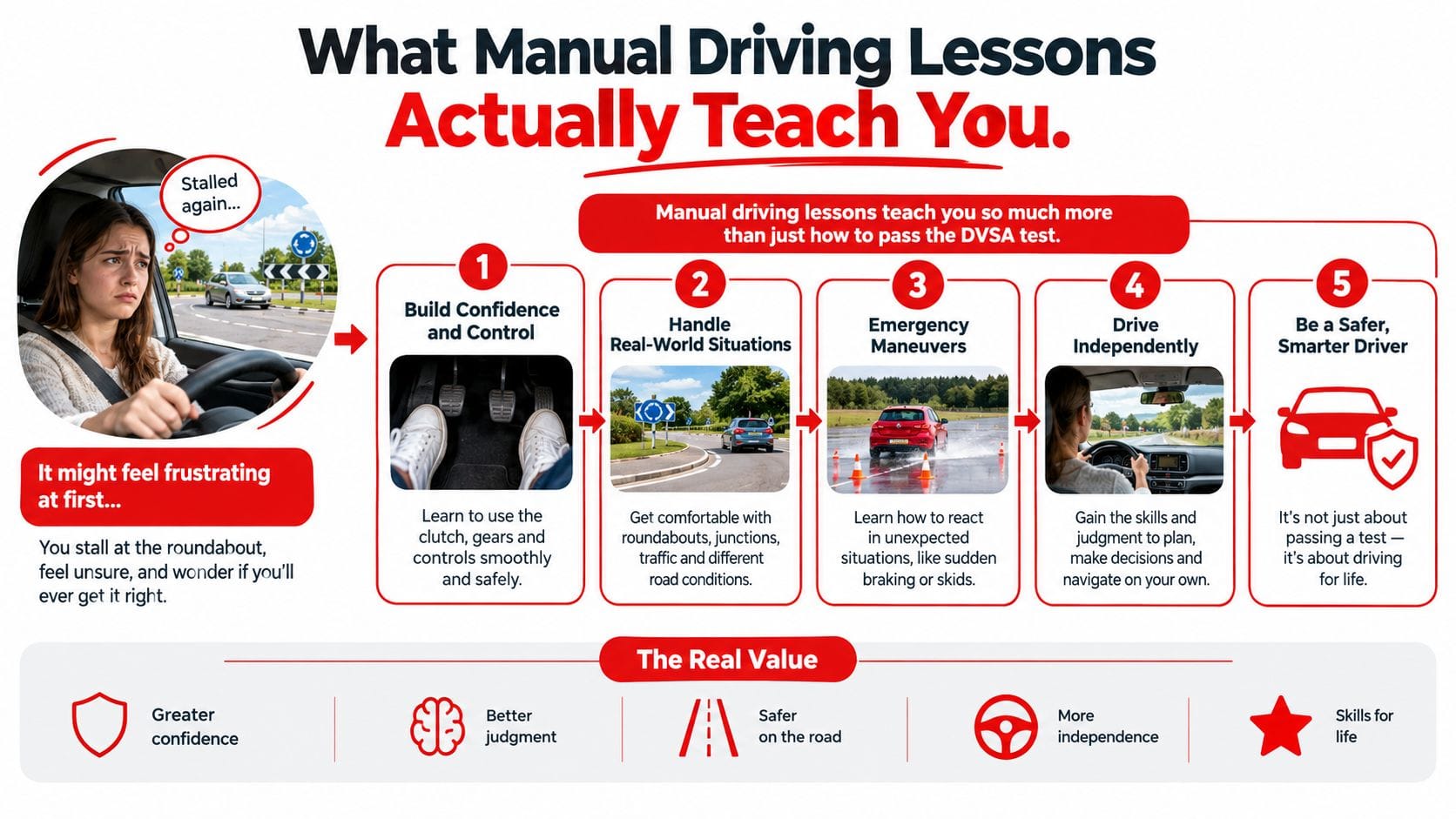
You're approaching a Southampton roundabout in a manual car. The bus behind you is getting closer, the lights have changed, and your left foot releases the clutch too quickly. The engine cuts out. Your stomach drops, but the situation is recoverable. A calm restart, a full scan of the junction and a measured move-off are more important than pretending the stall didn't happen.
That moment captures what manual driving lessons really teach. They're not only about changing gear or completing the practical test. They help you coordinate the car, read traffic, anticipate hazards and make decisions while the vehicle responds to your hands and feet. In 2026, automatic lessons are more visible than ever, but manual training still gives many UK learners a wider licence choice and a deeper understanding of vehicle control.
Table of Contents
- What Manual Driving Lessons Actually Teach You
- The UK Driving Syllabus for Manual Learners
- Why Manual Is Still the Default Choice in 2026
- Manual vs Automatic Lessons and Who Each Suits
- How Lesson Pricing and Structure Work
- Transitioning From Automatic to Manual
- Managing the Test-Wait Gap Without Losing Skills
- Choosing the Right School and Getting Started
What Manual Driving Lessons Actually Teach You
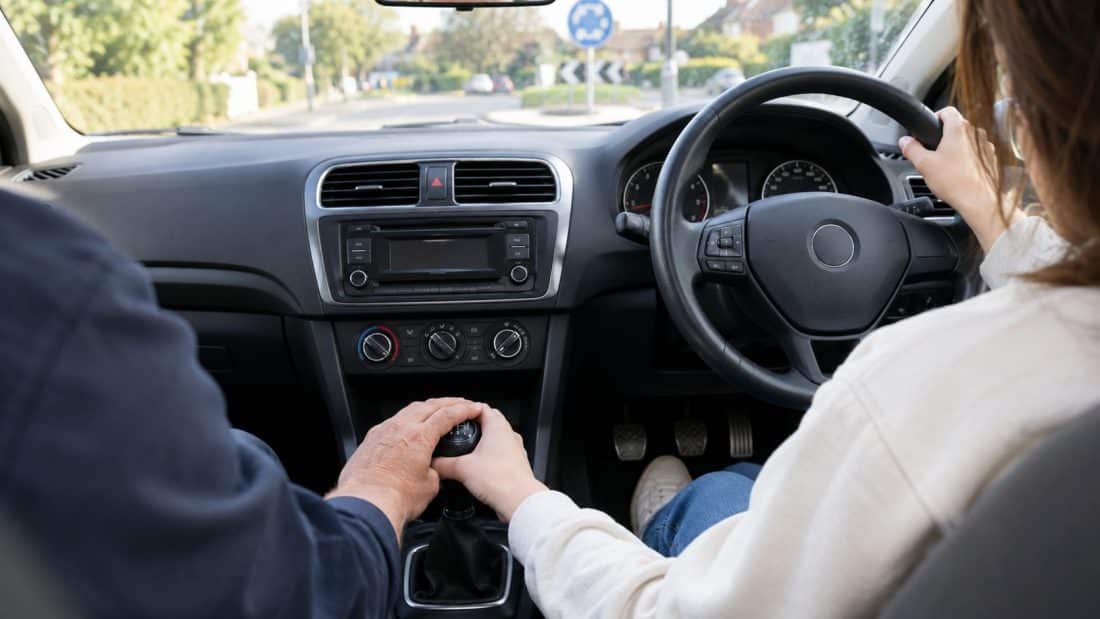
The first useful skill is recognising the clutch bite point. Your instructor will usually introduce it in a quiet area, where you can release the clutch slowly and feel the car begin to move without rushing to add power. You'll repeat the exercise until the movement feels predictable. If the engine stalls, you'll learn to secure the car, restart calmly and try again rather than treating the mistake as a disaster.
That control becomes practical on real roads. At a junction, you may need to select first gear, check mirrors, look for pedestrians and judge a gap while balancing the clutch. On a hill, you'll need enough control to prevent the car rolling backwards while you prepare to move. During a gear change, your attention must remain on the road, not on your hand moving the lever.
The mechanical skill supports the road skill
A good instructor doesn't teach clutch work in isolation. You'll practise:
- Moving off smoothly: Release the clutch progressively while watching the road, not the pedals.
- Changing gear with purpose: Select a gear that suits the car's speed, road gradient and the traffic ahead.
- Using mirrors early: Check what's around you before a change in speed or direction.
- Managing slow traffic: Keep the car controlled near a queue, crossing or busy roundabout without rushing.
- Anticipating hazards: Lift off early when a pedestrian, cyclist, parked vehicle or narrowing lane may affect your path.
Lessons should progress from quiet residential roads to busier junctions, dual carriageways and unfamiliar routes. That gradual increase matters because a learner who can change gear perfectly in an empty street may still need practice managing a clutch while reading signs, positioning correctly and responding to other road users.
Practical rule: If you're concentrating so hard on the gear lever that you stop scanning the road, the skill needs to be simplified and practised at a slower pace.
Manual driving also gives you an instinctive feel for engine response. You begin to notice when the car is working too hard, when it needs a lower gear and when you can allow it to roll smoothly without unnecessary input. This is why manual driving advice for beginners should focus on observation and decision-making as much as pedal technique.
The UK Driving Syllabus for Manual Learners
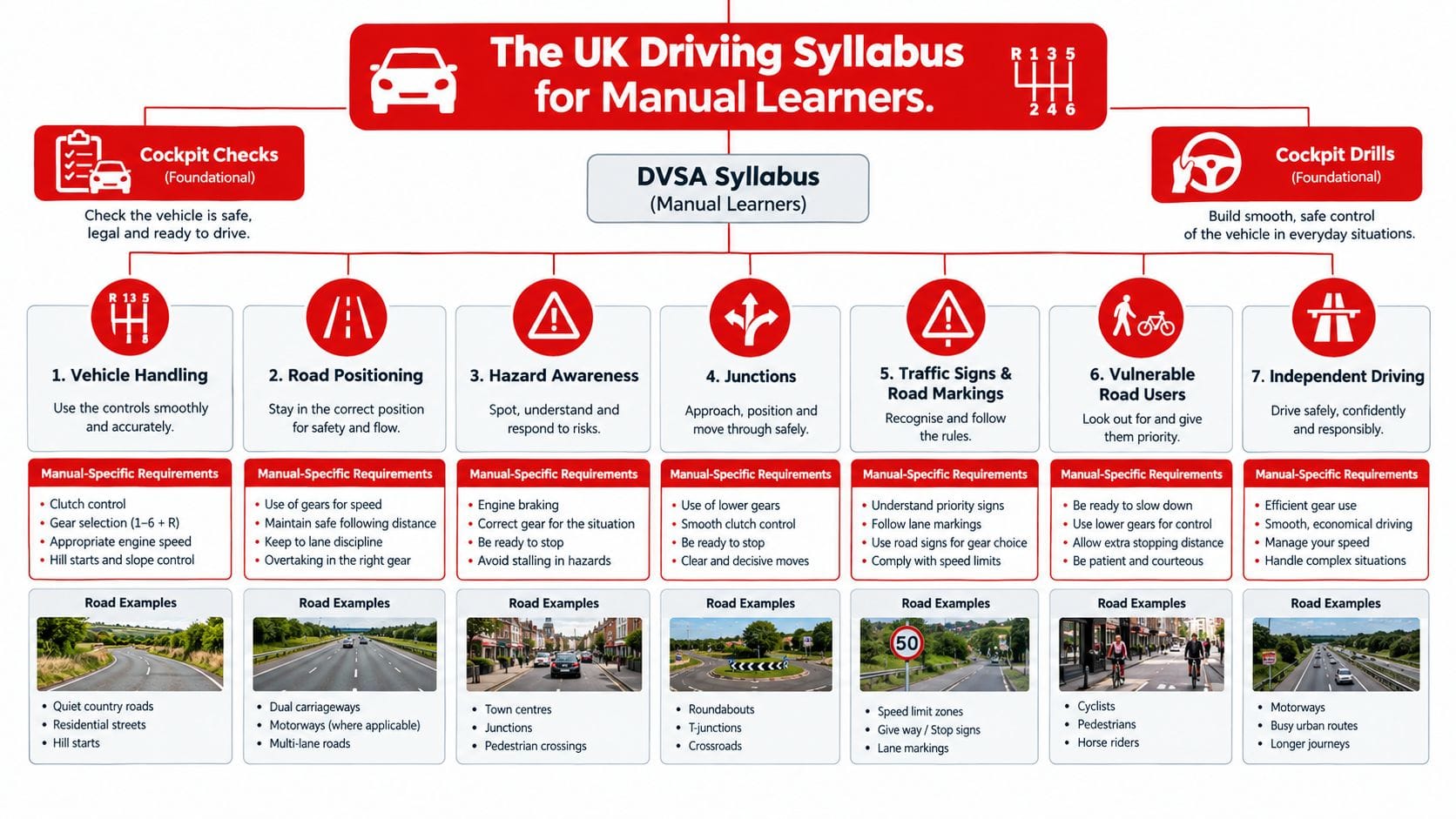
Manual learners follow the same broad road-safety syllabus as other learners, but they must demonstrate it while coordinating a clutch, gear lever and accelerator. The sequence makes more sense when you connect each topic to an ordinary road situation.
Start with the cockpit. Before moving, check your seating position, mirrors, seatbelt and controls. Learn where the lights, demisters, wipers and handbrake are located so you aren't searching for them while moving. Cockpit drills create a reliable routine, especially when you change vehicles or drive in unfamiliar conditions.
From preparation to traffic
The syllabus then moves into the essentials of safe road use:
- Mirrors, signals and position: Check what's behind and beside you before changing speed or direction. Signal only when it helps other road users understand your intention.
- Moving off and stopping: Secure the car, select the appropriate gear, check around you and move only when the space is safe.
- Junctions: Approach roundabouts, crossroads and T-junctions at a speed that gives you time to assess priority, position correctly and respond to developing traffic.
- Speed and clearance: Match your speed to the road, weather, visibility and hazards rather than treating a posted limit as a target.
- Manoeuvres: Use clutch control for slow, accurate movement during reversing exercises, parking and the turn-in-the-road manoeuvre where permitted by the test route.
- Independent driving: Follow signs, directions or navigation prompts while continuing to make safe decisions without constant instructor guidance.
Gear selection should serve the situation. First gear is normally for moving off. Second may help when you're crawling through a tight turn or slow queue. A higher gear can make steady progress on an open road, but only if the engine remains responsive and the car is stable. On a gradient, you may need a lower gear to maintain control and avoid making the engine struggle.
The familiar mirror-signal-manoeuvre routine isn't a set of boxes to tick once. It's a continuous rhythm. Before a roundabout, for example, you scan mirrors, read the signs and markings, choose a safe approach speed, select a suitable gear and keep watching for changes in traffic.
For a practical overview of test requirements, use this guide to the UK practical driving test. Your instructor should connect each exercise to everyday driving, because passing a manoeuvre is useful only when you can apply the same control safely outside the test centre.
Why Manual Is Still the Default Choice in 2026
Manual remains the main route for many UK learners because it keeps more vehicle options available after the test. A practical test taken in a manual car gives the driver access to manual and automatic vehicles, while choosing automatic from the beginning limits the licence to automatic cars. That distinction matters if your circumstances change later.
You might eventually need to borrow a family car, drive a work vehicle, hire a car abroad or choose from a wider used-car market. A manual licence doesn't force you to drive a manual every day. It avoids closing that option before you know what your future driving will involve.
The data also shows that manual training remains a major part of the testing system. Industry commentary recorded 1,538,314 practical tests in the UK during 2021/22, including 242,713 automatic tests, meaning manual tests still formed the majority at that point, as reported in this overview of manual driving lessons. More recent DVSA-linked figures reported by the BBC's coverage of Great Britain driving-test pass rates show a 50.4% manual pass rate compared with 43.9% for automatic in the financial year ending 2025.
Those figures don't prove that one gearbox is right for every person. They do challenge the idea that manual is automatically a worse route. The vehicle demands more coordination, but structured tuition can turn that coordination into a repeatable habit.
Manual versus automatic licence entitlements compared
| Driving scenario | Manual licence | Automatic-only licence |
|---|---|---|
| Driving a manual car | Permitted | Not covered by the automatic-only entitlement |
| Driving an automatic car | Permitted | Permitted |
| Borrowing different cars | Offers broader choice | Requires the vehicle to be automatic |
| Future work or travel options | Keeps manual vehicles available | May require additional training if a manual vehicle becomes necessary |
| Daily driving preference | You can still choose an automatic | Automatic is the required vehicle type |
Electric cars don't make manual learning pointless. An electric vehicle may feel very different from a petrol or diesel manual, but the wider licence entitlement can still matter for other vehicles you may encounter. Think of manual tuition as preserving flexibility, not committing you to a lifetime of clutch work.
Manual vs Automatic Lessons and Who Each Suits
The better choice depends on the driving life you expect, not on which lesson feels easiest during the first week. Manual lessons add clutch and gear coordination, while automatic lessons remove those tasks and let you focus more immediately on steering, traffic and positioning.
That difference can be valuable for a learner who feels overloaded by several controls at once. It can also be frustrating for someone who wants a broad licence and is prepared to practise the mechanical side patiently.
A direct comparison
| Factor | Manual lessons | Automatic lessons |
|---|---|---|
| Control | Teaches clutch balance, gear selection and speed control together | Removes clutch and manual gear changes |
| Licence flexibility | Allows driving manual and automatic cars after a manual pass | Restricts the licence to automatic vehicles |
| Early learning experience | May feel demanding while coordination develops | Often feels simpler at the beginning |
| Vehicle choice | Suits people who may use varied cars or work vehicles | Works well when an automatic car is always available |
| Anxiety | Stalls and hill starts can be stressful until practised | Removes stalling caused by clutch control |
| Long-term decision | Keeps more options open | Makes sense when the restriction is acceptable |
Manual is often a sensible fit if you may drive a van, use different family cars, travel where automatic hire vehicles aren't guaranteed or mainly want to understand more about how a car responds. It can also suit a learner with access to regular private practice in a manual vehicle.
Automatic may be the kinder choice for someone with a disability affecting pedal or limb coordination, a driver who expects to use only an automatic car, or a nervous learner whose main barrier is managing multiple controls. That isn't taking an easier route in a dismissive sense. It's choosing a vehicle that allows the learner to concentrate on safe road behaviour.
Use this manual or automatic lesson comparison to discuss the decision with an instructor, then ask yourself three questions:
- What vehicle will you drive after passing?
- Will a restricted licence create a problem if your work, car or location changes?
- Can you practise consistently without turning every session into a stressful test?
The right answer is the one that supports safe, sustainable driving.
How Lesson Pricing and Structure Work
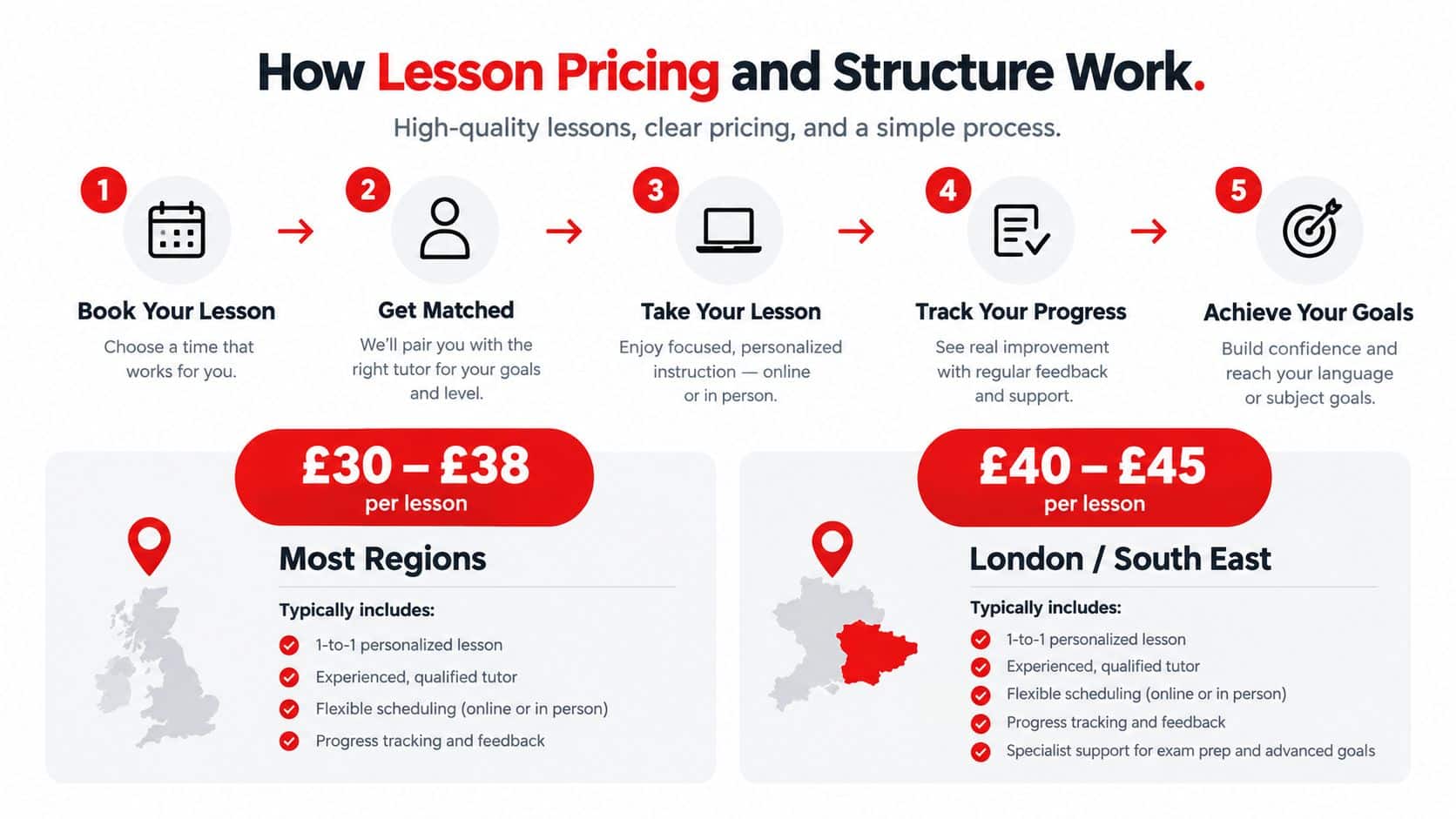
A learner preparing for a test in Sheffield may need a different booking pattern from someone practising after work in Bristol. Before paying, ask whether the school offers 60-minute, 90-minute or 2-hour lessons, and check exactly what each slot includes. Confirm whether a block booking, such as 10 hours, includes use of the instructor's car on test day or whether that is charged separately.
A standard weekly lesson gives clutch control, gear changes and road decisions time to settle between sessions. A longer booking can make sense when you need to reach unfamiliar roads, practise a full test route or link several skills in one drive. It should still leave enough concentration for safe decisions. Block bookings reduce repeated appointment arrangements, while an intensive course places more practice into a shorter period.
Match the structure to your life
Lendrum's lesson structure can be discussed as either a standard weekly pattern or a more intensive schedule. Weekly lessons suit learners who can practise privately and use feedback from one session before the next. Intensive training may fit a fixed period of availability, but only when a realistic test date and continued practice plan are in place. Completing the course does not mean your test will take place while your skills are at their sharpest, especially during long UK test waiting times.
Before booking, ask:
- What the price includes: Confirm the lesson duration, vehicle use and separate test-day charges.
- How cancellations work: Get the notice period and any fees in writing.
- How progress is measured: Ask how the instructor reviews clutch control, observations, manoeuvres and independent driving.
- Whether the instructor has availability: A lower-cost package loses value if sessions are often moved.
- What happens if your test is delayed: Agree how often you will drive to maintain your skills during the wait.
A longer lesson is not automatically better value. One focused session that corrects repeated stalling at a junction may help more than extra time spent repeating familiar roads. Your instructor should explain the skill being practised, the standard you are aiming for and the next action to take. That makes the booking easier to judge and helps prevent a gap before the test from undoing recent progress.
Transitioning From Automatic to Manual
A driver who passed in an automatic can read the road well, position safely and spot hazards, yet feel like a learner again when a clutch pedal appears. The traffic knowledge remains, while the physical routine must be built from the ground up. Moving off, changing gear and controlling speed now require your feet and hands to work in sequence.
Consider someone who passed in an automatic and later applies for a job involving a manual van. An automatic-only licence does not give them permission to drive that vehicle. They need suitable manual training and another practical test before taking on the role.
What the transition normally feels like
Early sessions should take place on quiet roads, where there is time to concentrate. You will find the clutch's bite point, move away, stop and feel what happens if you raise the pedal too quickly or use too little accelerator. Once that feels predictable, your instructor can build the routine into everyday UK situations.
On a hill, you will select a suitable gear and use a method that prevents the car rolling while you check the road. In a slow queue or during a manoeuvre, you will control speed without keeping unnecessary pressure on the clutch. At a roundabout or junction, you will select the right gear, observe, and move away without rushing. On faster roads, gear changes must happen without losing lane discipline or awareness of surrounding traffic.
A returning driver often adapts sooner than a complete beginner because signs, junction priorities and defensive driving already make sense. Existing confidence can also hide weak clutch habits. An instructor should therefore check the fundamentals rather than assume they are sound.
Manual practice should begin with a qualified instructor. Private sessions can follow once clutch control, gear selection and stopping are consistent. This approach also helps protect skills if a long test wait separates training from the appointment. A short, focused drive that revisits hill starts, roundabouts and slow traffic may keep the physical routine familiar better than occasional unstructured driving.
Managing the Test-Wait Gap Without Losing Skills
You handle a hill start, complete a practice drive at test standard and book your practical test. The appointment may still be many weeks away. Official and parliamentary evidence put the average car test wait in Great Britain at around 22 weeks in September 2025, compared with just over five weeks in February 2020. The National Audit Office investigation into driving-test waiting times reported that the DVSA did not expect to reach its seven-week target until November 2027.
Manual skills can fade during that gap because clutch feel and gear timing depend on regular physical practice. You may still know the rules yet hesitate at a busy roundabout, rush a hill start or lose smooth control in a slow queue. The AA reported that 58 test centres had the maximum 24-week wait in every month of 2025, so test planning needs to sit alongside lesson planning. Its centre-level findings are set out in the AA's report on driving-test waiting times.
Keep the routine alive
Arrange supervised practice in a suitable manual car, with a clear purpose for each drive. Clutch control works like muscle memory. Short, regular practice usually keeps it more familiar than occasional driving with no plan.
Use quiet roads first, then apply the same actions in ordinary UK traffic:
- Hill move-offs: Secure the car, find the bite point and move away without rushing.
- Gear changes: Build smooth progress through the lower gears before using faster roads.
- Slow control: Approach junctions, parked cars and tight turns without holding unnecessary clutch pressure.
- Observation rhythm: Link mirrors, signals, road position and speed changes into one routine.
- Emergency-stop preparation: Follow your instructor's method in a safe, legal location.
Keep a brief diary or phone note. Record what felt settled and what caused hesitation. If you stall at a roundabout, practise a calm restart and prepare earlier. If you ride the clutch, lift your foot fully once the car is moving steadily, then ask your instructor to check the habit. Jerky gear changes usually improve when you slow the sequence rather than force the lever.
Book a refresher lesson near the test, but leave enough time to respond to its findings. It may show that you need route practice, manoeuvres, confidence work or a return to basic clutch drills.
Choosing the Right School and Getting Started
Your first task is to find an instructor who teaches the person, not just the syllabus. Check that the instructor is a registered DVSA-approved driving instructor, ask how they structure progress reviews and find out whether the car is suitable for your height, mobility and learning needs.
Reviews can help, but read them for detail. Comments about calm explanations, punctuality, useful feedback and confidence on difficult roads are more informative than a vague rating. Ask whether you'll have the same instructor consistently, whether the school is a franchise or an independent operation, and what happens if your regular instructor is unavailable.
A practical first month
During the first lesson, treat the session as an assessment rather than a performance. You and the instructor should establish how the clutch feels, how you respond to instructions, what your mirror routine looks like and whether the pace needs to be slower or faster.
Then organise the basics:
- Book theory preparation: Use the official DVSA route for the theory test and ask your instructor which topics need attention.
- Set a weekly pattern: Choose times you can protect, including private practice if a suitable supervisor and vehicle are available.
- Agree progress markers: Decide when you'll review moving off, junctions, manoeuvres, independent driving and test readiness.
- Discuss intensive training carefully: Confirm the proposed schedule, the test plan and how you'll maintain skills if the date changes.
- Consider post-test training later: Motorway tuition or Pass Plus may be useful after you've built basic solo-driving experience, depending on your needs.
Watch for red flags. Cash-only payment with no clear receipt, an unclear cancellation policy and an instructor who ignores mirror checks during the first lesson all deserve scrutiny. You should feel able to ask why an exercise matters, report anxiety and request another explanation without being made to feel foolish.
A calm instructor won't promise that every learner will progress at the same speed. They'll help you build control in stages, review your decisions carefully and prepare you for the roads you'll drive around Southampton, Portsmouth, Winchester, Plymouth or wherever your licence takes you.
If you're ready to build clutch control without rushing, Lendrum's Driving School offers manual lessons, intensive courses, theory support and flexible training across Southampton, Portsmouth, Winchester, Plymouth and surrounding areas. Visit Lendrum's Driving School to discuss your goals, availability and the right lesson structure for your test plan.
Book a lesson today
Book NowReady to pass your driving test with friendly, professional tuition and boost your confidence on the road? Book your lessons with Lendrum’s Driving School today and start your journey to becoming a safe, skilled driver.