
Driving Test Centre Winchester Pass Rates and Booking
Winchester's April 2025 to March 2026 car practical-test pass rate was 52.2%, with 2,404 passes from 4,602 tests, against a Great Britain average of about 50%, according to Pass Driving Test's DVSA-based Winchester figures. Its April 2023 to March 2024 rate was 49.1%, as reported in the Hampshire Chronicle's analysis.
A pass rate works like a weather average: it summarises other people's tests rather than predicting yours. Book when you can handle changing road conditions without your instructor stepping in, because no waiting list can shortcut readiness.
Table of Contents
- Winchester Pass Rates Beside Other Hampshire Centres
- Why a Stronger Pass Rate Is Not an Easier Test
- What Automatic and Manual Results Change in Training
- Manoeuvres Marked for Control and Observation
- Winchester Roads Worth Rehearsing Before Test Day
- What Examiners Check on Test Day
- Book Only When Your Driving Is Already Consistent
Winchester Pass Rates Beside Other Hampshire Centres
For April 2025 to March 2026, Pass Driving Test's DVSA-based Winchester figures report 52.2%, with 2,404 passes from 4,602 tests, against a Great Britain average of about 50.0%. For the earlier, directly comparable Hampshire year, April 2023 to March 2024, the Hampshire Chronicle's analysis of DVSA-held data reports Winchester at 49.1%, with 3,051 passes from 6,218 tests, alongside the centre results below.
Hampshire car practical pass rates, April 2023 to March 2024
| Centre | Passes | Tests | Pass rate |
|---|---|---|---|
| Winchester | 3,051 | 6,218 | 49.1% |
| Farnborough | 6,253 | 10,712 | 58.4% |
| Basingstoke | 2,781 | 4,792 | 58.0% |
| Lee-on-the-Solent | 7,221 | 12,557 | 57.5% |
| Portsmouth | 5,655 | 11,237 | 50.3% |
| Southampton Maybush | 5,650 | 12,809 | 44.1% |
Winchester sat below Farnborough, Basingstoke, Lee-on-the-Solent and Portsmouth in that comparison, but above Southampton Maybush. That's a useful correction to the idea that a centre has a permanent reputation as easy or difficult.
The Hampshire analysis also carries a qualification: the dataset isn't classified as an official statistic subject to UK Statistics Authority assessment. It remains a useful comparison, provided you keep the period and measure attached to it.
Compare like with like
Don't compare a newer Winchester result with an older result elsewhere and call it a current ranking. Different reporting periods can give a misleading impression of the gap between centres.
A centre's overall result combines many candidates, including people with different experience, preparation and familiarity with the area. Traffic and examiner assessments form part of that setting too, but the headline rate doesn't separate their effects.
Choose somewhere you can prepare properly, not somewhere you hope will compensate for unfinished learning.
If Winchester is familiar and your instructor can provide the test car there, that practical fit matters. Moving elsewhere solely for a stronger percentage can mean spending valuable lesson time learning an unfamiliar road environment.
Keep theory and practical booking tasks separate as well. If you're also preparing for a motorcycle qualification, Theory Bookings' motorcycle theory test centre finder helps with that separate search, rather than identifying a car practical-test appointment.
Before choosing a centre, check current DVSA information rather than treating any historical year as fixed.
Why a Stronger Pass Rate Is Not an Easier Test
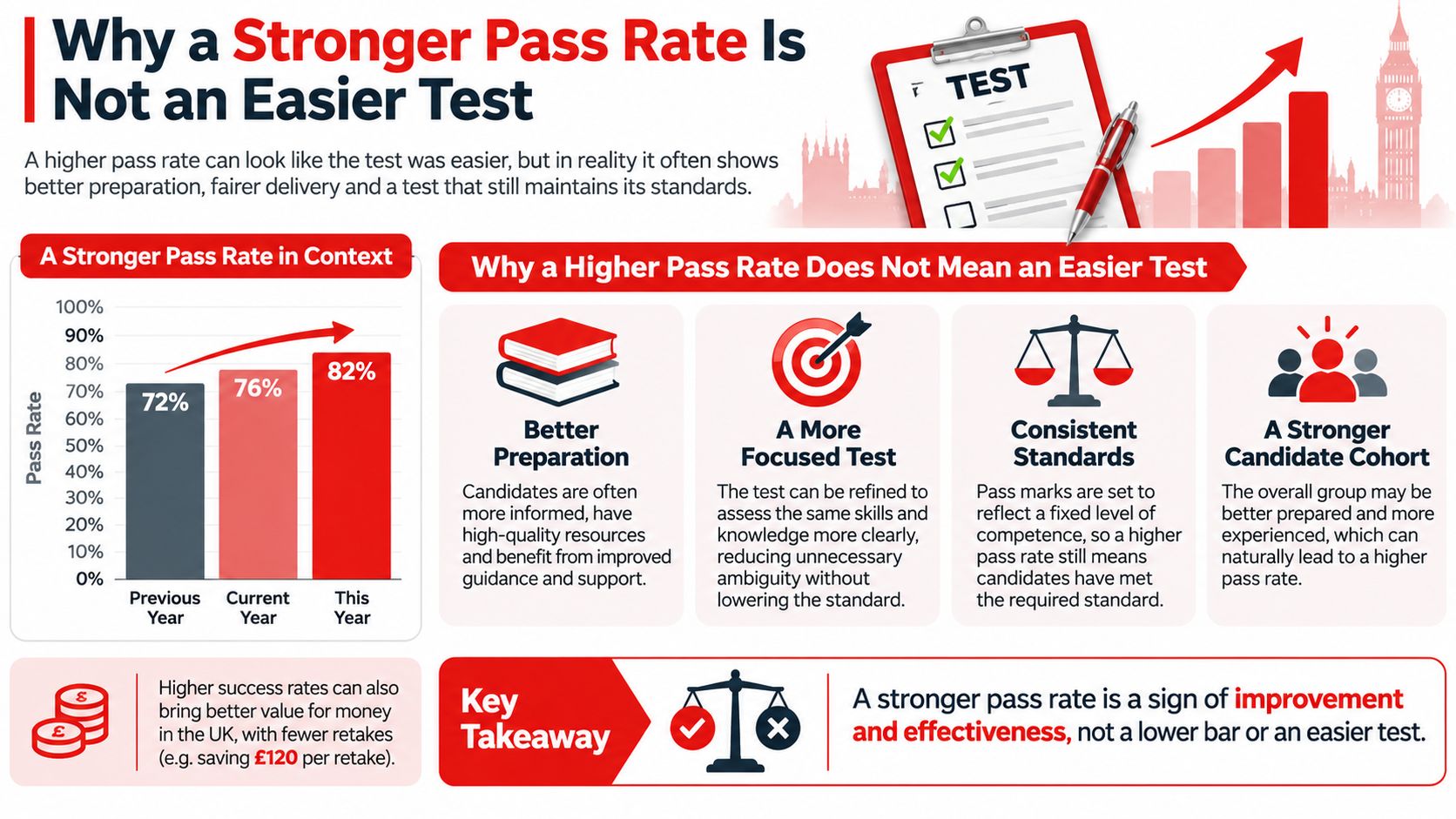
An above-average pass rate doesn't establish that Winchester offers an easier test. It tells you what happened to a group of candidates, not why those candidates achieved those results.
Within the latest annual period discussed above, MyDrivingTest's Winchester analysis reports monthly results ranging from 47.9% in December 2025 to 60.3% in March 2026. That variation is a strong reason not to treat an annual average as your personal probability of passing.
The visual below highlights the distinction between preparation and assumptions about difficulty.
What the headline leaves unanswered
Candidates and instructors may choose a centre because it's familiar, because an appointment is available, or because they believe its roads will suit them. Those choices affect who takes the test there, so you can't isolate route difficulty from the pass rate alone.
The annual headline doesn't tell you:
- First-time outcomes. It doesn't identify your prospects as a first-time candidate.
- Reasons for failure. It doesn't show which faults caused unsuccessful attempts.
- Individual road difficulties. It doesn't reveal whether a particular learner struggled with hills, junctions, rural approaches or dual-carriageway transitions.
Say you're comfortable on open roads but hesitate at busy junctions. Another learner may make confident junction decisions but struggle to adjust speed when leaving town. Both take a test at the same centre, yet their preparation needs are quite different.
The useful target is transferable judgement: noticing hazards, planning early, choosing an appropriate speed and making decisions independently. Memorising where an instructor usually turns won't help much when traffic blocks that turn or a different instruction takes you somewhere unfamiliar.
Check current DVSA information when planning your preparation. Treat local familiarity as support for good driving, not a substitute for it.
What Automatic and Manual Results Change in Training
Winchester's published automatic-test records show 379 passes from 859 tests, a 44.1% pass rate, while another reporting period records 606 passes from 1,312 tests, or 46.2%, in the DVSA automatic car-test spreadsheet. These are centre-specific records, not national benchmarks or a matched comparison proving that automatic tests are harder than manual tests.
An automatic removes clutch operation and gear selection from your workload. It doesn't choose a safe gap, notice a cyclist beside you or decide when to reduce speed.
That distinction matters if you're changing transmission because manual lessons feel overwhelming. The change may free up attention, but you still need to use that attention effectively.
Practise in the car you'll use
Build familiarity with the intended test car's accelerator response, braking feel, dimensions and visibility. Don't assume that confidence in a manual training car transfers immediately to an unfamiliar automatic.
For example, approaching a queue requires a smooth reduction in speed and a controlled stop. If the car responds differently from what you expect, you need rehearsal rather than a last-minute explanation outside the test centre.
Our guide to automatic driving lessons can help you consider the change without treating it as a shortcut.
Training priority: Use any reduction in gearbox workload to look further ahead, not to relax your observation.
Include varied Winchester urban conditions in practice, rather than spending most of your time on quiet streets. Junction approaches, lane changes and independent navigation should feel manageable in ordinary traffic.
Before committing to the test, check that you can:
- Hold an appropriate speed without repeated reminders.
- Use mirrors before changing speed or position, then respond to what you see.
- Make junction decisions independently, rather than waiting for reassurance.
The right transmission is the one in which you can demonstrate those skills consistently. Neither gearbox can do the decision-making for you.
Manoeuvres Marked for Control and Observation
A manoeuvre is a risk-management task, not an exercise in finishing between painted lines. Think of reversing from a driveway while someone walks along the pavement: where the car ends up matters, but so does everything happening around it.
The DVSA examiner guidance assesses reverse parking through effective all-round observation, accurate control and safe responses to other road users, identifying incorrect control or inaccuracy and ineffective observation as fault categories. Its manoeuvre assessment covers pulling up on the right and reversing, reverse bay parking, parallel parking and forward parking.
Use this visual as a reminder to assess safety alongside positioning.
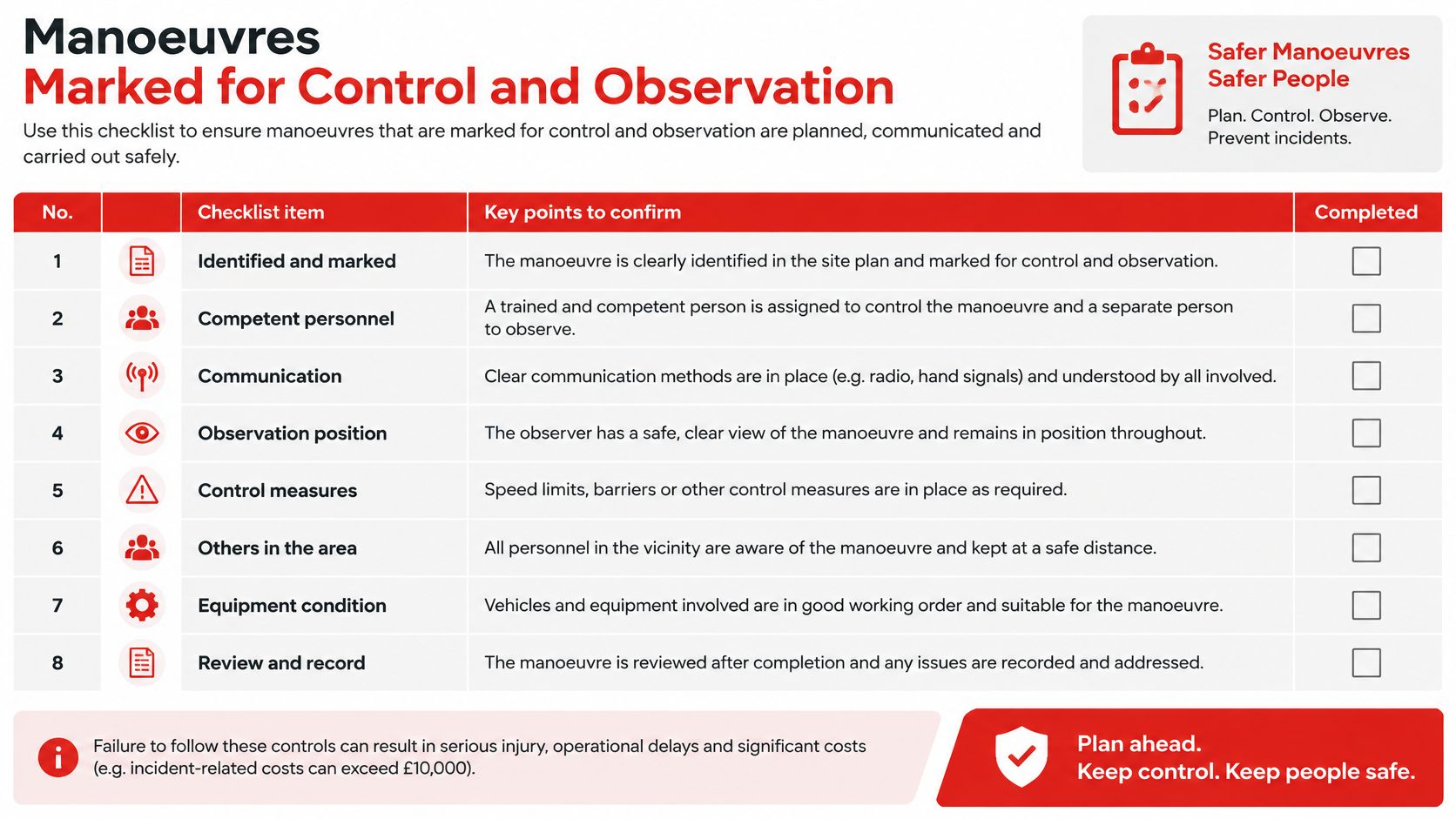
A repeatable observation sequence
- Observe before moving. Check around the car, including areas the mirrors don't show.
- Keep control slow and deliberate. Leave yourself time to notice changes.
- Continue scanning. Don't fix your eyes on a mirror or reference point throughout the reversal.
- Stop when circumstances change. Reassess if someone approaches or the available space changes.
- Reposition safely if needed. Don't force the car into an unsuitable angle.
For parallel parking on a Winchester street, a reference point may help you judge when to steer. But if passing traffic approaches, your priority is deciding whether to pause, not reaching that reference point on schedule.
For bay parking, say a pedestrian walks behind the car. Stop, keep watching and resume only when the space is safe. A straight finish doesn't cancel out missed observation.
For practical help with positioning, use our reverse parking tips alongside your instructor's feedback.
Watch the demonstration with particular attention to the driver's observation and pauses.
Judge each practice attempt by what you noticed and how you responded, not only whether the wheels finished straight. That habit remains useful when the bay, slope or surrounding traffic differs on test day.
Winchester Roads Worth Rehearsing Before Test Day
Practise road situations, not a supposedly fixed Winchester route. Routes and traffic change, so these scenes are preparation examples rather than a map to memorise.
Use the visual as a prompt for varied practice, not a prediction of your drive.
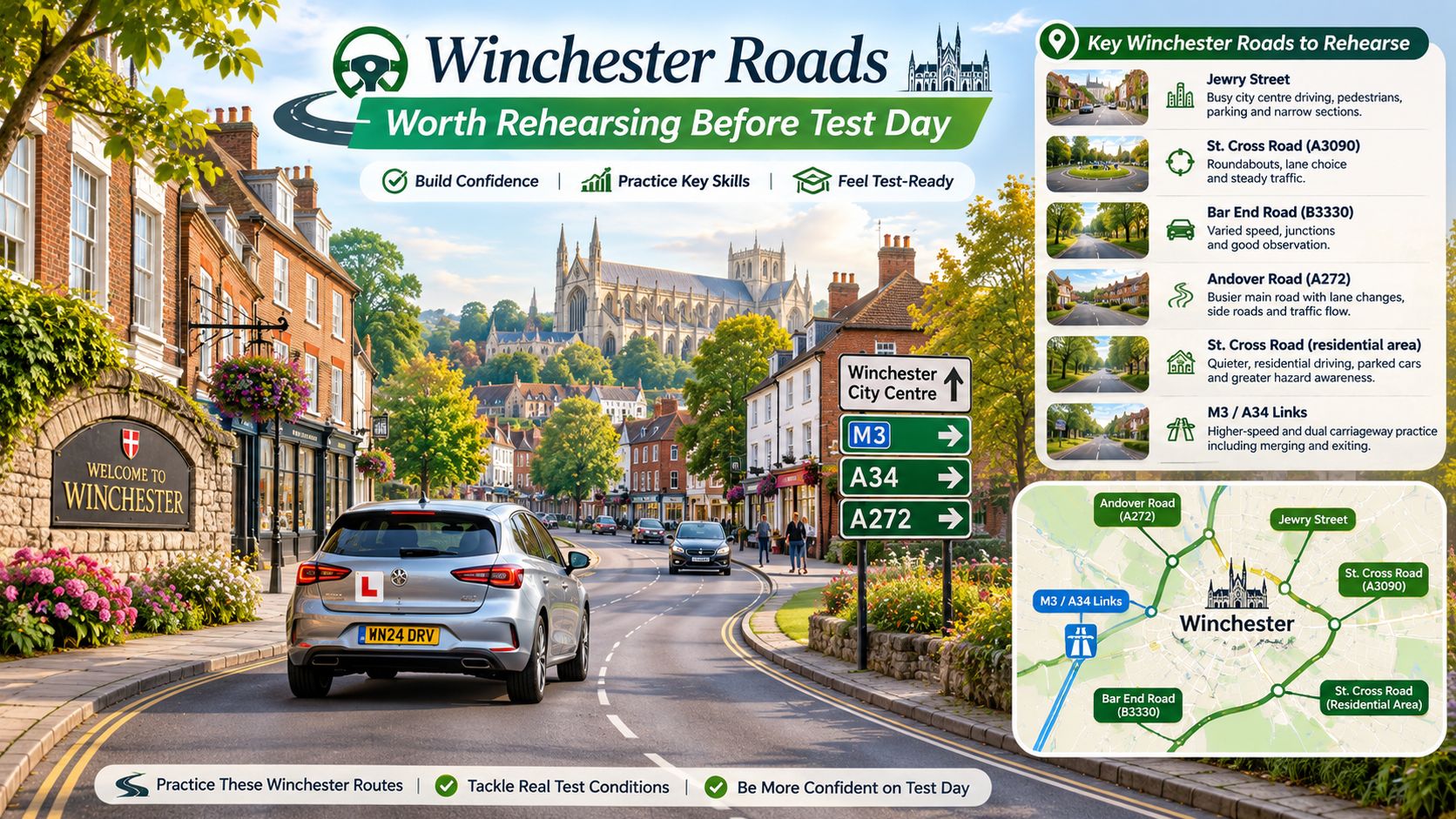
Different roads, different decisions
At a busy urban junction, you approach in the correct lane but can't yet see clearly past parked traffic. Slow enough to assess the view, keep checking for pedestrians and cyclists, and choose a gap because it's safe, not because someone behind appears impatient. This rehearses observation and planning.
On a sloping approach, you stop behind another vehicle. Leave space, secure the car and prepare to move without rolling backwards or rushing the release of the brake. The skill is controlled coordination, using the clutch where applicable.
At a transition onto a faster dual carriageway, town-driving habits need to change. Check mirrors, assess the joining opportunity and build speed appropriately for the conditions, without assuming another driver will make room. This develops independent speed judgement rather than just driving faster.
Make unfamiliar instructions ordinary
Ask for practice following sat nav directions and road signs on roads you haven't just repeated. If you miss a turn, continue safely and allow the route to be corrected instead of making a sudden manoeuvre.
After the lesson, record whether mirror use was unprompted, speed remained legal and appropriate, and you could complete a manoeuvre while still noticing other road users. Note the specific moment that needed help, such as selecting a lane too late.
That gives the next lesson a useful objective instead of a vague aim to feel more confident.
What Examiners Check on Test Day
Prepare the morning so you're not solving avoidable problems at the last moment. Put your provisional licence photocard ready, confirm arrangements for the car and check current DVSA document and vehicle requirements before travelling.
Arrive with enough time to settle yourself. Use any spare time to get comfortable and listen carefully, rather than trying to memorise a final collection of turning points.
Follow the process calmly
Expect an eyesight check, vehicle-safety questions and a drive in which you demonstrate safe control and judgement. Rehearse the safety questions in the actual car so you know where its controls are, rather than relying on an answer learned without seeing the vehicle.
During independent driving, follow the navigation instructions while continuing to prioritise signs, road markings and safety. If an instruction isn't clear, ask for clarification when it's safe to do so.
A missed direction needs a safe response, not an abrupt correction.
The examiner records driving faults separately from serious and dangerous faults. Don't try to diagnose your result while you're still driving: that distracts you from the next junction, crossing or change in traffic.
Your final preparation check
- Documents ready. Check the current requirements before leaving home.
- Suitable car arranged. Confirm availability and roadworthiness in advance.
- Observation established. Use mirrors and direct checks because the situation calls for them, not to put on a performance.
- Recovery rehearsed. After a mistake, breathe, refocus and deal with the road ahead.
You can't undo an earlier moment by worrying about it. You can still make a careful decision at the next opportunity, which is why calm recovery belongs in your lessons as well as on test day.
Book Only When Your Driving Is Already Consistent
There usually isn't a waiting list you can join to bypass appointment searches. The DVSA guidance on appointment releases and earlier tests says most centres don't operate waiting or cancellation lists: earlier appointments become available when candidates cancel or move bookings, and learners must find them through the booking service.
A published waiting-time measure isn't the date you personally can secure. A median describes the middle of a set of waits, while the appointment that suits you also depends on your availability, preparation and access to a suitable car.
The process below keeps the booking decision tied to your driving.
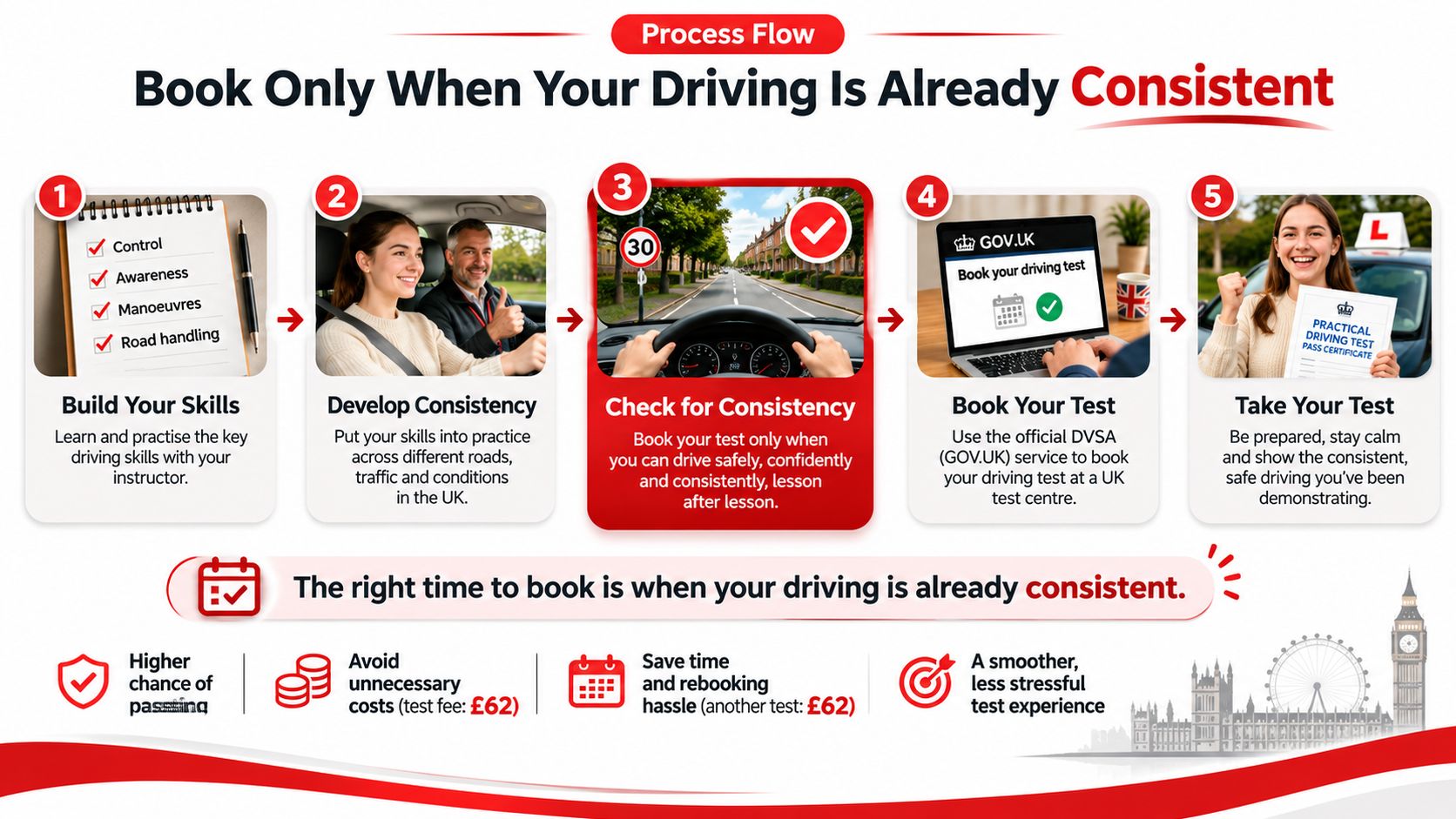
A booking routine that protects preparation
- Establish readiness first. Have your theory passed and make sure independent driving is consistent, rather than occasionally successful.
- Choose a workable date. Leave room for the lessons you still need instead of selecting the earliest appointment automatically.
- Check the official booking service regularly. Use a manageable routine, without assuming a paid service can guarantee a place in a queue.
- Confirm the practical arrangements before moving. An earlier appointment isn't useful if your instructor or intended test car is unavailable.
- Reassess if prompting continues. If you still need help to recognise hazards or make safe decisions, discuss moving the test rather than hoping pressure will resolve the problem.
Our guide to driving test cancellation apps provides context for considering those tools. Keep the central question practical: can you use the appointment without losing necessary preparation?
When to book or keep a Winchester test date
| Situation | What to do | Why |
|---|---|---|
| Independent driving still needs prompts | Delay the booking | An early slot does not create the missing skill |
| Theory passed, manoeuvres and local roads consistent, test car available | Book, then watch for cancellations | The official booking service is where earlier dates appear |
| Earlier cancellation clashes with lessons or the test car | Keep the original date | A shorter wait is useless without practice time |
Decide from your recent driving
Look for repeatable performance across different lessons and conditions. A clean drive on familiar roads is encouraging, but it's not the same as handling an unfamiliar instruction, a blocked lane or a difficult junction without help.
Ask your instructor to identify the remaining interventions precisely. Did they remind you to check a mirror, help you judge a gap or prevent an unsafe action? Those details make it easier to decide whether another lesson should target observation, control or planning.
Check current DVSA booking information before making changes. Secure a date that fits demonstrated readiness, rather than allowing the calendar to dictate when you must be ready.
Lendrum's Driving School offers structured tuition for nervous beginners and learners working towards a test on a short timeline, with intensive courses available in Andover, Salisbury, Southampton and Winchester. Visit Lendrum's Driving School to discuss focused lessons on the roads and manoeuvres still causing difficulty, before taking or moving your Winchester test date.
Book a lesson today
Book NowReady to pass your driving test with friendly, professional tuition and boost your confidence on the road? Book your lessons with Lendrum’s Driving School today and start your journey to becoming a safe, skilled driver.