
Driving Instructor Course: The Complete UK Guide

You've probably had the same thought at some point: the commute is fine, the job pays the bills, but it doesn't feel like a career you'll want in five years. A driving instructor course can look like a clean escape hatch, steady work, useful skills, and a role where people remember the person who helped them pass. The catch is that in the UK, “becoming an instructor” is not one short course. It's a regulated path with checks, timed stages, and a real job waiting on the other side.
Table of Contents
- What a Driving Instructor Course Actually Involves
- Entry Requirements You Must Meet Before You Start
- Inside the Three-Part ADI Qualification
- Comparing Training Options, Costs and Timelines
- The Trainee Licence and Your First Real Teaching Hours
- Preparing for the ADI Standards Check
- Life After Qualifying and the 2026 Regulatory Shift
What a Driving Instructor Course Actually Involves
A lot of people start by searching for a driving instructor course as if it's one programme you book, attend, and finish. In reality, the UK route is a three-part qualification run by the DVSA, and each part tests something different. Part 1 checks theory and hazard perception, Part 2 checks driving ability, and Part 3 checks whether you can teach safely and effectively, not just drive well.
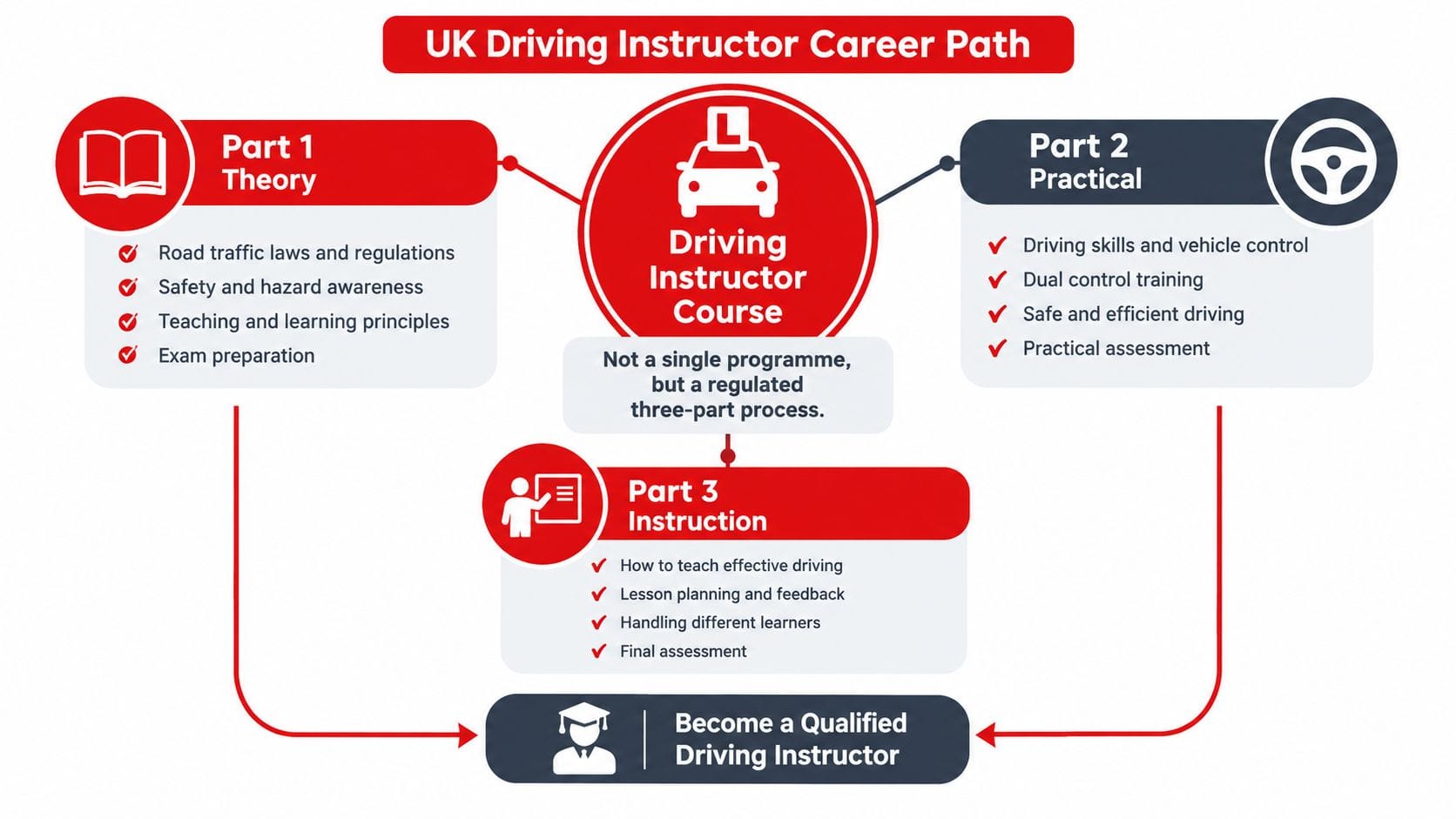
A useful way to think about it is this. Learning to drive is one thing. Learning to teach someone else to drive is another, because you have to spot risk early, explain it clearly, and keep the lesson safe while a nervous pupil is making mistakes in real time. That's why marketing that promises a fast route to “becoming an instructor” can be misleading. The qualification is structured, supervised, and assessed against national standards, not personal enthusiasm.
What happens after the exams
Passing the three parts does open the door, but it doesn't mean you're finished. Trainee teaching, Standards Checks, and ongoing registration are part of the job once you qualify. In other words, the course is the start of a regulated occupation, not the end of training.
Practical rule: if a provider talks only about passing exams, and never about what happens once you're teaching real pupils, you're looking at half the picture.
For a trainee looking at options in the South of England, a school that offers instructor support alongside learner tuition, such as instructor training in driving schools, can help make that transition feel less abstract. The important point is the structure. A good course prepares you for the tests, but it should also prepare you for the day you're sat next to a pupil who freezes at a roundabout and needs calm, clear coaching.
Entry Requirements You Must Meet Before You Start
Before you pay for training, screen yourself against the rules. The first requirement is a full UK or EEA car licence held for at least four years. You also need to be 21 or older by the time of ADI registration, and you must not have been disqualified from driving in the previous four years. A DBS-enhanced criminal records check is also part of the process.
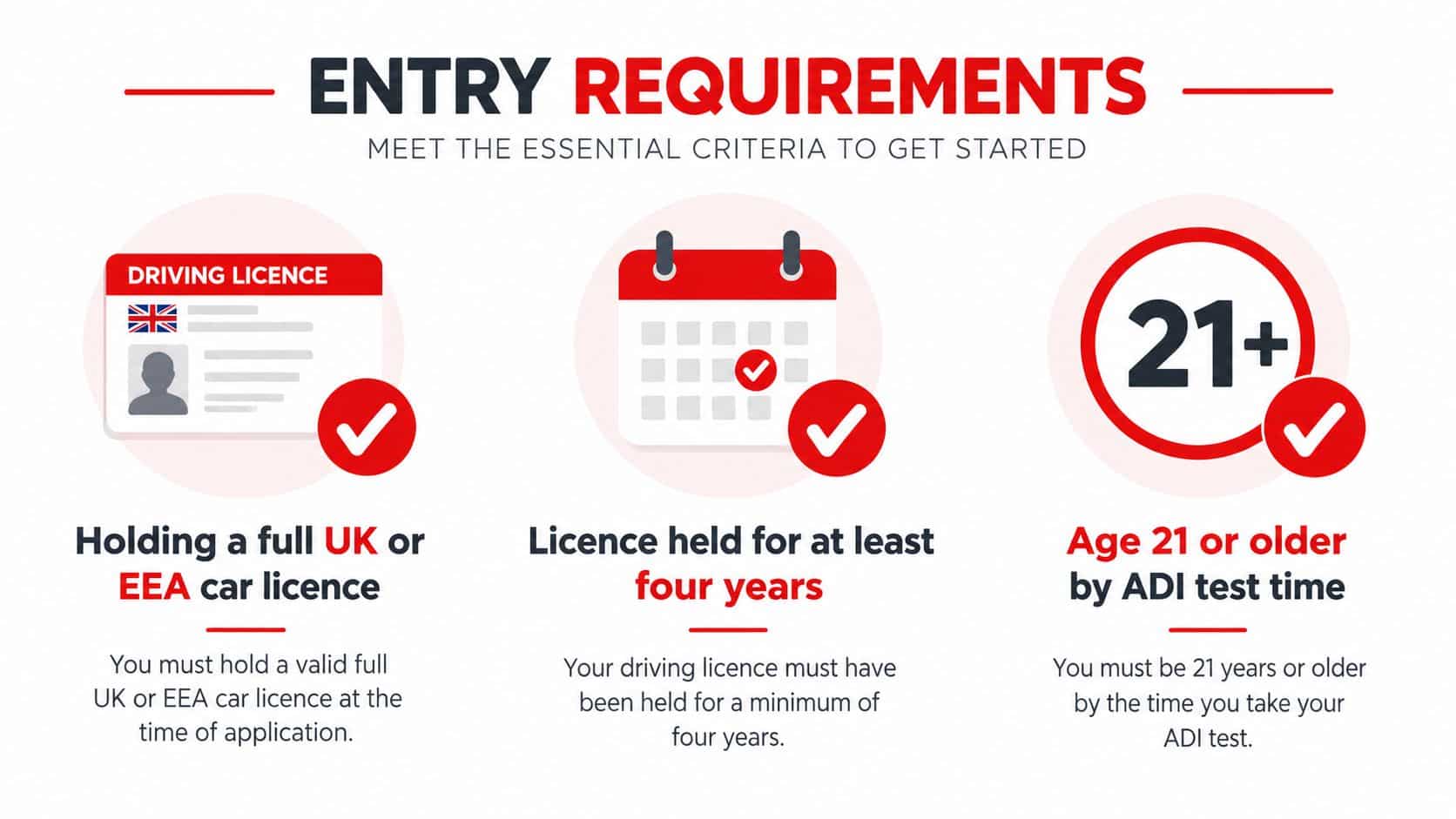
These aren't boxes for the sake of it. A person who's going to sit beside learner drivers needs a stable recent driving history, enough maturity to handle responsibility, and the background checks that support pupil safety. That's also why the route is split between ADI and PDI stages. ADI is the full qualification. PDI is the trainee phase, and the gates are different because the law treats supervised teaching differently from full registration.
A quick self-check before you commit
- Licence history: make sure your car licence covers the required period before you book training.
- Age timing: check your age against registration, not just your test date.
- Driving record: recent bans and penalty points can affect eligibility.
- DBS readiness: plan for the enhanced check early so you don't get delayed later.
If any one of those areas is uncertain, pause before spending money on a course bundle. Training providers can coach technique, but they can't fix ineligibility after the fact.
A good rule is to treat eligibility like insurance. You don't think about it much when everything is in order, but the moment something is missing, the whole plan stalls.
One point often missed by career-changers is that this profession is regulated for a reason. You're not being filtered out by bureaucracy, you're being screened for a role that puts you in control of someone else's safety and learning environment.
Inside the Three-Part ADI Qualification
The ADI route works in sequence, and the sequence matters. Part 1 comes first, then Part 2, then Part 3. The DVSA says candidates must complete the later stages within two years of passing Part 1, or the process has to be restarted. That's one reason a serious course has to plan learning, practice, and revision together instead of treating them as separate boxes.
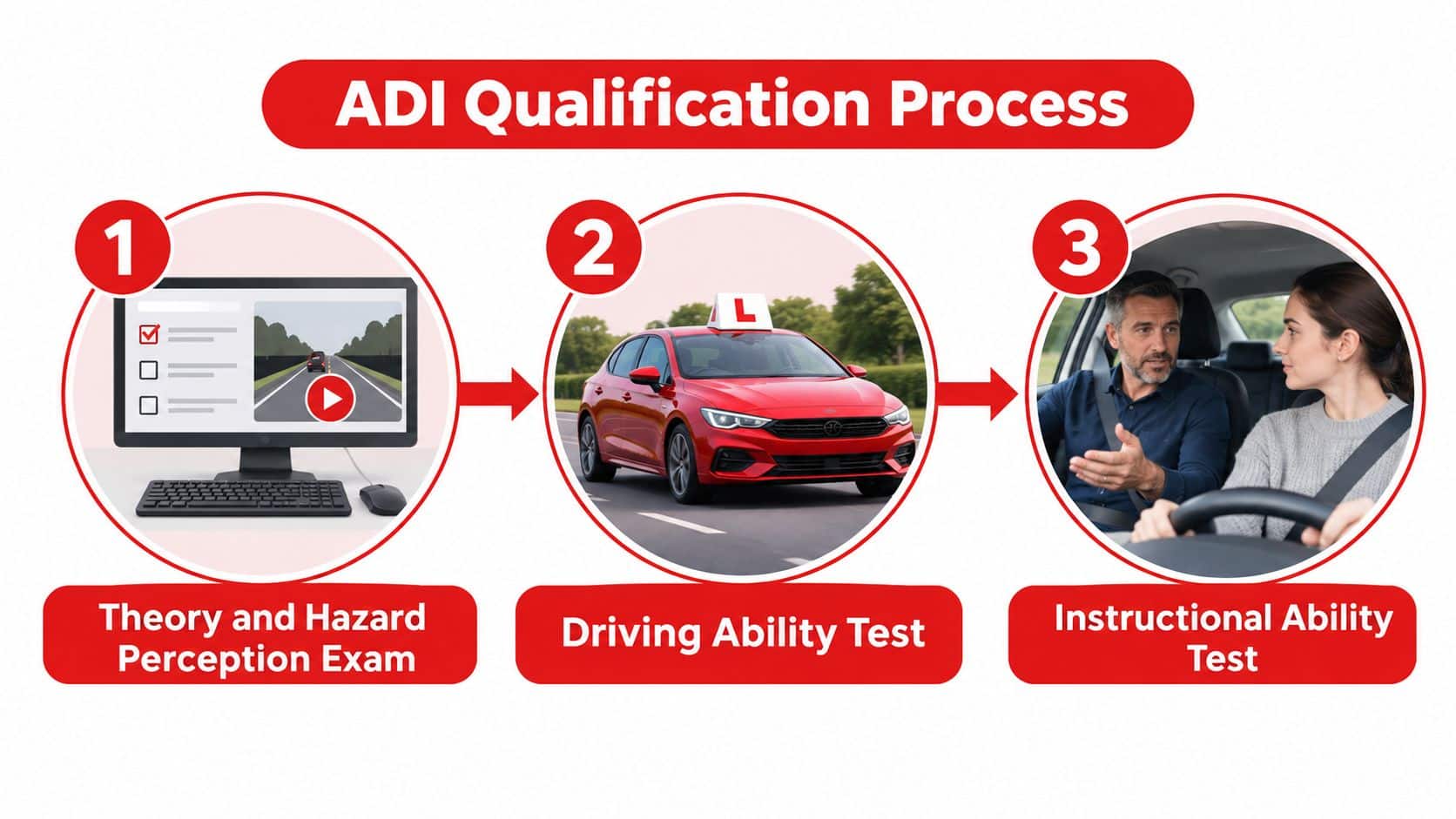
Part 1 tests driving theory and hazard perception. That means you're not only revising road rules, you're proving that you can read developing risk quickly. Part 2 is the advanced driving test, and it looks for a higher standard than the ordinary learner test. Part 3 is where many candidates underestimate the challenge, because the examiner is judging your instructional ability, not just your car control.
What tends to trip people up
A strong driver can still struggle on Part 3 if the lesson feels unstructured, the pupil isn't asked questions in the right way, or risk is left unmanaged. A weak explanation of a manoeuvre can cost you because the examiner is looking for teaching that is safe, clear, and adaptable.
Useful test-day mindset: drive like a professional, teach like a professional, and don't assume that either skill carries the other.
The workload behind the qualification is bigger than you might expect. Part 1 needs focused theory revision. Part 2 needs advanced road practice and self-awareness about habits you may have built over years of ordinary driving. Part 3 needs repeated teaching practice, lesson debriefs, and the habit of explaining decisions in plain language. That combination is what makes the route more than a driving test with extra steps.
Comparing Training Options, Costs and Timelines
A career-changer often starts by asking two practical questions. How fast can I qualify, and how much structure do I need to stay on track?
The answer depends on your week, your budget, and how well you work under pressure. An intensive course compresses the learning into short blocks, which suits people who can step away from work and family demands. A part-time course spreads the same work across evenings or weekends, which is easier to keep alongside a job but can feel slower. Blended training sits between the two, with theory study at home and in-car sessions used for the parts that need live coaching.
| Format | Typical Duration | Best For | Main Trade-off |
|---|---|---|---|
| Intensive bootcamp | Short, concentrated blocks | People who can step away from work and focus fully | Hard to balance with family and employment |
| Part-time evening or weekend course | Spread over a longer period | Career-changers who need continuity with current work | Progress can feel slower |
| Blended online plus in-car training | Flexible mix of self-study and practical sessions | Self-directed learners who like structure but need flexibility | Requires discipline between lessons |
| Franchise-school programme | Varies by provider | Candidates who want training plus a route into business support | Less independence early on |
The money side is wider than tuition. You need to budget for test fees, mock assessments, training time, and access to a suitable trainer car for advanced practice. If you are comparing franchise work with independent training, the business side matters too, because support can affect your cash flow after qualification, not just during the course.
What budget planning should cover
- Training delivery: course tuition, coaching sessions, and feedback.
- Testing: DVSA exam costs across the three stages.
- Vehicle access: trainer-car hire or a suitable training vehicle.
- Lesson materials: theory resources, mock tests, and lesson planning tools.
A sensible budget also needs to match your availability. A short course can work well if you can keep up with revision and practice between sessions. A part-time route may suit someone with family commitments better, even if the calendar stretches out.
If you want a South of England provider that offers instructor training alongside learner tuition, Lendrum's Driving School is one option to compare with others on support, timing, and local coverage. The right choice is the one that fits your budget, your diary, and the way you learn best.
The Trainee Licence and Your First Real Teaching Hours
Once Part 2 is passed, many candidates expect to move straight into the next exam and nothing else. In practice, the trainee stage is where the job starts to feel real. The trainee licence lasts for six months, but it isn't automatic. You need to be attached to a registered training school and show that the required training has been completed before you can teach under that licence.

This is the point where the classroom version of the job meets actual driving instruction. You may take paying pupils under supervision, but you're still developing judgement. That matters because many future Part 3 and Standards Check habits are formed here, when you're learning how to plan a lesson, explain a mistake, and move on without rattling the pupil.
What a typical trainee week can look like
A sensible week usually has three moving parts. First, actual pupil lessons. Second, observed sessions with a mentor or supervising trainer. Third, preparation time for Part 3 and lesson planning. If those three things stop competing with each other and start supporting each other, progress becomes steadier.
The costs here are easy to underestimate. Dual-control vehicles, insurance, fuel, and maintenance all sit behind the scenes, and they affect whether the trainee stage is financially manageable. That's why some people use the trainee licence as a bridge, while others wait for full qualification before trying to run a business.
Why the trainee stage is useful
- You get live teaching practice: not just mock role-play.
- You see how pupils behave: nerves, mistakes, silence, confidence swings.
- You learn lesson rhythm: explain, demonstrate, debrief, repeat.
The value of the stage is simple. It turns abstract teaching theory into a routine. And once that routine is built, Part 3 stops feeling like an artificial role-play and starts feeling like a polished version of what you already do.
Preparing for the ADI Standards Check
A lot of instructors treat the Standards Check as a test to survive. That mindset is too narrow. The DVSA examiner watches approximately 45 minutes of a client-centred lesson, with around three minutes for agreeing goals and managing risk, about 40 minutes of pupil driving, and roughly three minutes for learner reflection. The lesson is scored across 17 competencies, grouped into lesson planning, risk management, and teaching-and-learning skills.
The stronger way to prepare is to use pupil outcomes, not just your own sense of how a lesson went. DVSA monitors a rolling 12-month picture, including thresholds such as an average of 6 driving faults per test, 0.55 serious faults per test, examiner intervention in 10% or more of tests, or an overall pass rate of 55% or lower. If three or more triggers are reached, a Standards Check booking is requested.
How to use this in day-to-day teaching
The point isn't to obsess over numbers. It's to notice patterns. If a pupil repeatedly misses mirror checks on lane changes, that tells you something about lesson sequencing, not just that the pupil is “weak at mirrors”. If one topic keeps producing confusion, the fault log should change the next lesson plan.
Practical rule: use the last five lessons to shape the next one. If the same fault keeps appearing, the lesson design needs work, not just the pupil.
That approach also helps with continuing professional development. Instead of trying to “revise the Standards Check” the night before, you build habits that make the lesson cleaner all year round. A provider that helps you review fault patterns and lesson structure, such as the driving instructor training Standards Check guidance, is useful because it keeps the preparation tied to real teaching.
The final insight is simple. The Standards Check is not separate from your job. It measures the job itself.
Life After Qualifying and the 2026 Regulatory Shift
Passing Part 3 feels like the finish line, but the business of instructing begins there. You still need to think about registration renewal every four years, how you'll handle vehicle costs, and whether franchise work or independent work suits your hours, your risk tolerance, and your cash flow. That choice matters because the job isn't only teaching. It's also scheduling, administration, and keeping pupils moving through lessons in a way that works for them and for you.
A realistic first year should include spare time for cancellations, admin, and the slow build of a reputation. If you're setting up locally, the basics of visibility matter too, including a clear profile and accurate business information online. A useful practical resource on that side of the business is Google Business Profile optimization, because pupils often compare local options before they ever make a call.
What changes in 2026
From 12 May 2026, instructors will no longer be able to book or manage car driving tests for learner drivers. The government also says the voluntary ADI code of practice will become mandatory, and instructors will need to declare that they've read and agreed to it when applying, renewing registration, or applying for a trainee licence. That means regulatory awareness is becoming part of professional competence, not just office admin.
The practical response is to separate pupil coaching from test administration. Keep your teaching systems tight, keep your compliance paperwork current, and build a simple transition checklist for the new rules. A day-in-the-life view of the occupation, like the one on Lendrum's Driving School's instructor career page, helps show how much of the role sits away from the wheel.
The strongest instructors won't just know how to teach a clutch or a manoeuvre. They'll know how to run a compliant business, explain change calmly to pupils, and keep adapting as the rules shift around them.
If you're weighing up whether this career suits you, Lendrum's Driving School can help with structured instructor training, Standards Check preparation, and local driving tuition across the South of England. Visit Lendrum's Driving School to see how its training support fits your route into the profession.
Book a lesson today
Book NowReady to pass your driving test with friendly, professional tuition and boost your confidence on the road? Book your lessons with Lendrum’s Driving School today and start your journey to becoming a safe, skilled driver.