

Driving Test Minors and Majors: The Pass Rules

Minors are driving faults, and you can collect up to 15 and still pass the UK car test. One serious or dangerous fault, the faults learners call majors, fails the test immediately.
That rule sounds generous until you see how often a small repeated slip becomes the reason for a fail. Age adds another twist to planning. The government statistics for 2011/12 recorded a 56% practical-test pass rate for 17-year-olds, the highest of any age group, while only 36% of tests taken by people aged over 35 resulted in a pass. Treat driving test minors and majors as a readiness check, not as points you're allowed to spend.
Table of Contents
- What Counts as a Minor or a Major
- How Examiners Grade One Action
- Faults That Stay Minor or Turn Major
- Cut Repeated Faults and Choose the Next Lesson
- When to Book With a Long Test Wait
- Reading the Report and Rebooking
What Counts as a Minor or a Major
Start with the pass line, because everything else follows from it. You pass with no more than 15 driving faults and zero serious or dangerous faults. One major fails you even if you've driven almost perfectly for the rest of the test and picked up only one or two minors.
The names cause much of the confusion. Learners say minors and majors, but the examiner's report uses different words. On the GOV.UK guidance on driving test faults and your result, a driving fault is below the standard expected of a safe, competent driver but isn't potentially dangerous. You may accumulate up to 15 and still pass, provided there are no serious or dangerous faults.
The Four Rows on the Report
| Official name | Learner name | What it means | Allowed | Result |
|---|---|---|---|---|
| Driving fault | Minor | Below the expected standard but not potentially dangerous | Up to 15 | Pass if there is no serious or dangerous fault |
| Serious fault | Major | Potentially dangerous, or a possible breach of the law | Zero | Immediate fail |
| Dangerous fault | Major | Actual danger to the candidate, examiner, public or property | Zero | Immediate fail |
| Same driving fault repeated | Minor that can become a major | A persistent pattern rather than one isolated slip | Can be marked serious | Fail even if the raw total is under 16 |
Keep that last row in mind during lessons. A repeated fault can show the examiner a persistent pattern rather than a one-off slip, and that pattern can be marked serious. That's why counting to 15 on its own doesn't tell you whether you're ready.
Practical rule: Fifteen is a ceiling, not a target. A pass with three driving faults shows far steadier driving than a pass on the limit.
What the Examiner Is Actually Recording
You won't see a live tally while you're driving. The examiner marks behaviours on the driving test report, grouped by things like observation, control, junctions, mirrors and response to signs. You find out the total afterwards, when the result is explained.
That matters for how you practise. If you only ask your instructor, "How many minors was that?", you'll miss the pattern underneath. Ask instead which behaviour kept appearing. Three scattered faults in different areas tell a different story from three faults all marked under observation at junctions.
This explanation covers the Great Britain car practical test only. Motorcycle, lorry and trailer tests use their own standards and reports, so don't carry these numbers across to a different licence category.
Use two benchmarks before you think about test day. First, zero majors in your recent practice drives. Second, a minor count that's falling and doesn't keep landing on the same behaviour. If both are true, you're looking at stable driving, not a lucky day.
How Examiners Grade One Action
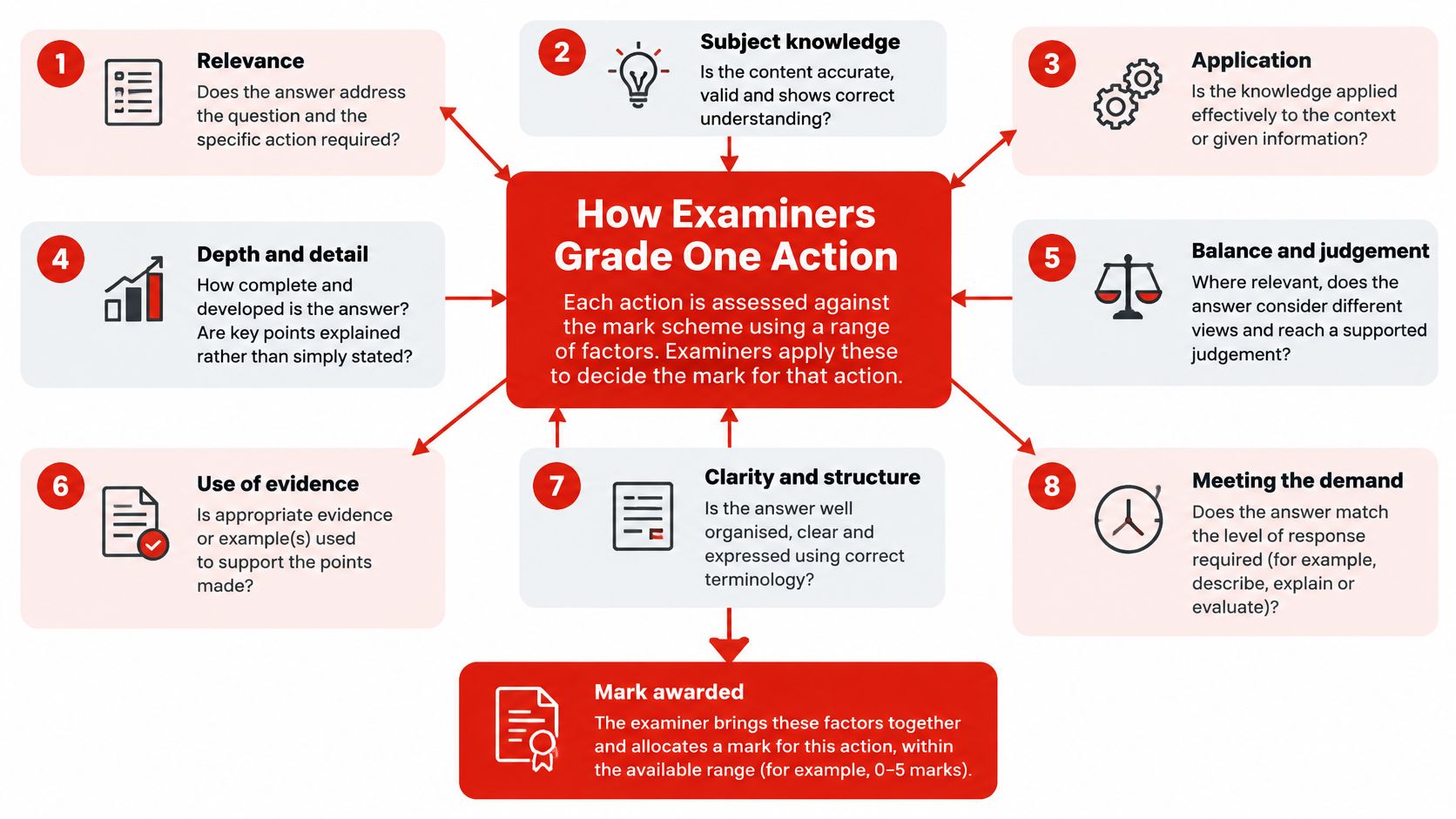
Examiners grade what your action did, not whether anyone was hit. Did another driver have to brake, swerve or wait because of you? Did a pedestrian hesitate? Did you break a rule of the road? The answers decide whether the mark lands as a driving fault, a serious fault or a dangerous fault.
The diagram below sets out the grading factors examiners weigh up in the moment.
A Slip That Stays Minor
A driving fault is a standard that slipped while the situation stayed safe. Say you check your mirror a fraction late before slowing on an empty residential road. Nobody's behind you, nobody's affected, and your speed and position stay controlled. The standard dipped, so it's marked, but it created risk for no one.
The same late check on a busy dual carriageway is a different event entirely. The examiner isn't scoring your intention or your effort. They're scoring the effect of what happened, in that traffic, at that speed, with those road users around you.
Potential Danger and Actual Danger
A serious fault is potentially dangerous or may involve a breach of the law. Emerging from a junction so that an approaching driver has to brake sharply is the classic case. So is failing to give way where the law requires it, even when the other driver manages to avoid you.
A dangerous fault involves actual danger to you, the examiner, the public or property. Moving into the path of a vehicle that has to swerve to miss you sits here. The GOV.UK guide to understanding your car driving test result confirms that intervention isn't required for a fault to be classified as dangerous, though an examiner taking action to prevent an incident is a strong practical warning sign.
A collision isn't required for either type of major.
So don't take comfort from "nothing happened". The examiner doesn't have to grab the wheel or use the dual controls. If your decision created the danger, the mark follows the decision.
Learners sometimes compare test systems while they study, and a guide that helps you understand Ontario G test scoring will show different labels on the sheet. On the GB car test the question stays the same throughout: what did the action do to the people around you?
When Repetition Changes the Grade
Several small misses of the same skill can be marked serious as a group. Mirrors forgotten before signals, observations missed at junction after junction, clearance squeezed past parked car after parked car: each one alone might stay minor, but together they show a competency that isn't stable yet.
A leaking tap works the same way. One drip is a minor. A tap that keeps dripping points to a fault in the system, which is how the examiner reads a fault that keeps returning.
Review each practice drive by effect, not by memory. Ask who had to slow down, change course or wait because of you, and whether the law was met at every point.
That habit changes how you prepare and when you book. When a lesson produces potential danger, make it the priority for the next one, even if no incident resulted. With a long wait for a test date, a booking spent before a repeated fault is resolved is a booking spent on the wrong day.
Faults That Stay Minor or Turn Major
The same behaviour can sit in either column. What moves it is the effect on the people around you. Work through these seven familiar moments and notice how little separates the two versions.
Mirrors and Junctions
Mirrors. You check your centre mirror slightly late before signalling on a quiet street with nobody behind you. That's a driving fault. Now picture the same late check as you move off or change lane, and the driver beside you has to brake to avoid you. The observation failure has created potential or actual danger, and it's now serious or dangerous.
Junctions. You arrive at an empty T junction, look both ways, hesitate a moment too long, then emerge safely. That hesitant look usually records as a minor, sometimes under undue hesitation. Contrast that with emerging in front of approaching traffic so another driver has to slow sharply. Nothing about your hand position changed. The effect on traffic did, and the grade follows.
Signals and Control
Signals. Your indicator goes on a little late approaching a turn, but it still tells the truth and nobody's misled. Minor. Now imagine signalling left while your road position says you're going straight on, and a driver waiting to emerge pulls out on the strength of your signal. A signal that sends the wrong message creates danger for someone acting in good faith, which pushes it into major territory.
Control. You stall once at a quiet junction, apply the handbrake, restart calmly and move off safely when it's clear. Examiners see a recovered slip, and it's normally a minor. A stall on a roundabout with traffic bearing down, a rollback towards the car behind you on a hill, or steering so wide on a turn that you leave your lane unsafely all tell a different story. Control faults turn major when the car goes somewhere other road users didn't expect.
Clearance and Speed
Clearance. You pass a parked car a touch closer than ideal on a wide road, with a clear view and nobody about. That's a minor for clearance. Squeeze past a cyclist without enough room, or pass close to a child standing at the kerb, and you've put a vulnerable road user at risk. The distance might look similar from your seat. The consequence of a wobble or a step forward is completely different.
Speed. Travelling slightly below the flow where it's safe, perhaps on a wet unfamiliar road, can record as a progress fault. Crawl so slowly that a queue builds behind you and frustrated drivers start overtaking in risky places, and your caution is now creating the hazard. At the other end, drifting over the speed limit is a legal breach, and sustained speeding moves firmly towards serious.
Signs and Lights
Response to signs and lights. You react a beat late to a changing light but still stop safely and legally at the line. Minor. Rolling through a give way without looking, crossing a stop line into the junction, or going through a red light are majors, because each one either breaks the law or puts you where other drivers have a right to expect an empty space.
Don't memorise lists of slogans. Take your last three lessons and mark honestly which column each fault belonged in, minor as it happened or major as it nearly was.
That exercise is uncomfortable and useful in equal measure. Most learners find one or two behaviours that keep drifting towards the major column. Those are the ones your next lessons should be built around.
Cut Repeated Faults and Choose the Next Lesson
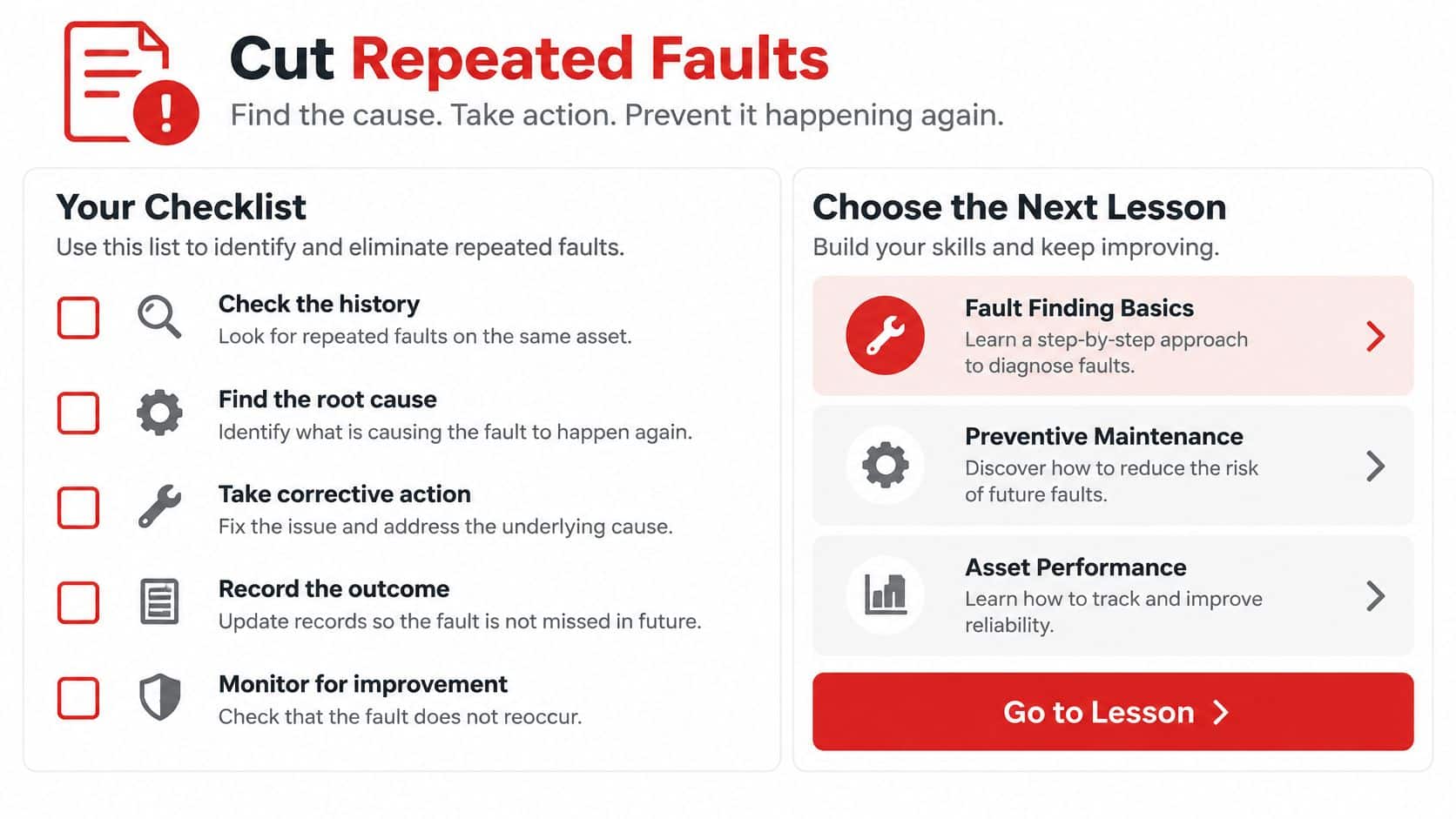
General confidence tips won't fix a repeated fault. A routine tied to your mock test sheet will, because it forces each lesson to answer the last drive. Run this with your instructor after every mock.
The checklist below summarises the routine so you can keep it beside your lesson notes.
The Six Step Routine
- Copy the report by behaviour. After every mock, rewrite the faults under headings for mirrors, junctions, signals, move off, control, positioning, progress and response to signs. A list sorted this way shows patterns that a raw total hides.
- Circle anything that appears more than once. That behaviour is your likely serious fault risk, even if the total sits comfortably under 15. One-off slips can wait.
- Spend the next lesson on that one behaviour. Practise it on mixed roads, not on a memorised test route. You're building a habit that holds anywhere, not a performance for one junction.
- Use short commentary at key moments. Saying "mirrors, signal, gap check" out loud on junction approaches and lane changes pulls your observation earlier, which gives you time to act on what you see.
- Set a stability test for manoeuvres. Require three consecutive attempts at a bay park or parallel park without the same error before you call the skill stable. One clean attempt proves you can do it, not that you reliably do.
- Repeat a full mock and compare sheets. Run it under test conditions, including independent driving following signs or a sat nav, then lay the new report beside the old one.
Watching how a structured mock debrief works can help you set yours up.
Choosing What Happens Next
Let the latest sheet decide. If any serious or dangerous fault remains, don't treat your test date as fixed. Book lesson time against that behaviour until it disappears from your mocks, because one major outweighs everything else on the report.
If your minors are scattered across different behaviours, not repeated, and comfortably under 15, keep normal lessons and place a final mock nearer the date. If one behaviour repeats, make it the only goal of the next few hours of tuition. Ready to book means zero majors with a driving fault total well under the ceiling.
National figures underline why guessing is risky. The DVSA driving test and theory test data for cars shows a practical car-test pass rate of 48.9% in July to September 2024, from approximately 449,000 tests in Great Britain. A mock that still produces a major isn't an unlucky edge case.
A structured instructor keeps the mock log and sets one goal per lesson. Lendrums Driving School, for example, offers manual and automatic lessons across Southampton, Portsmouth, Winchester and Plymouth with that kind of goal setting built in. Pair that log with a read of the school's guide to common mistakes by first time drivers and how to avoid them and you'll spot your repeated behaviour in its pages quickly.
When to Book With a Long Test Wait
Booking used to be a simple reward for feeling ready. The queue has changed that calculation. The National Audit Office investigation into car driving test waiting times reported an average wait of 22 weeks in September 2025, compared with just over five weeks in February 2020, with only 73 of 240 permanent test centres below 24 weeks.
Local waits in Southampton, Portsmouth, Winchester and Plymouth can differ substantially from that average. Check the figure for your own centre rather than treating 22 weeks as your personal date. The guide on how to book a driving test walks through the booking steps once you've chosen your approach.
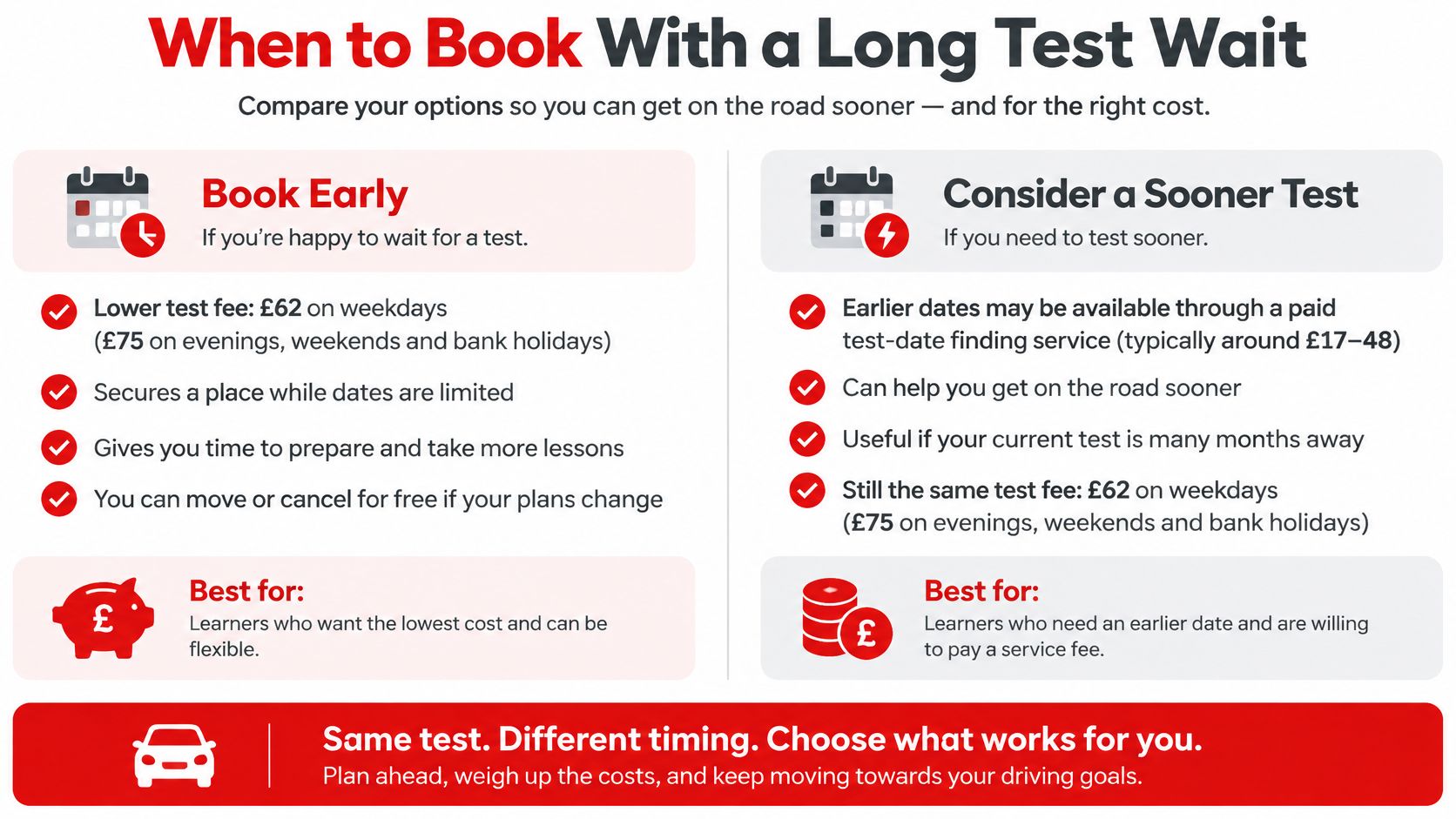
The comparison below frames the two main ways learners handle a long queue.
Two Pathways Through the Queue
| Pathway | What you gain | Main risk | Suits you if |
|---|---|---|---|
| Book a provisional date and keep training | A slot about 22 weeks out on the 2025 national average, with time to practise | Sitting while a repeated fault can still be marked serious | Lessons are already regular and the date is far enough to fix one behaviour |
| Wait until mocks are stable, then book | The test matches a sheet with zero majors and minors comfortably under 15 | Adding months of queue time after you're ready, so skills and confidence drift | The same fault is still appearing, or work and college block weekly practice |
Neither pathway is wrong on its own. The benchmark decides. A provisional date works when your lesson frequency gives you enough hours to extinguish the repeated fault well before the day, with room to repair a bad mock. Waiting works when your sheet still shows a pattern that could be marked serious.
Cancellations and Life Constraints
Earlier slots appear, but only move your test forward when your last mocks meet the benchmark. Don't take a short notice cancellation to escape nerves while a repeated junction or mirror fault is still on the sheet. A nearer date doesn't fix the behaviour, it just examines it sooner.
Life constraints differ by learner, and they're legitimate planning inputs. A 17-year-old may be juggling college timetables, access to a parent's car and insurance timing. An adult may be switching from manual to automatic or fitting lessons around shift work. Neither situation changes the pass line, but both change how many practice hours fit between now and a test date.
Decision rule: Book the date that leaves enough lessons to remove your repeated fault, plus one spare mock to prove it's gone.
Reading the Report and Rebooking
A fail feels personal in the car park, but the report is only behaviours with grades beside them. Read it in the right order and it becomes the plan for the hours before your next attempt.
Six Steps From Report to Rebooking
- Find any serious or dangerous fault first. One major alone explains the fail, so start there before counting minors. The examiner's end-of-test explanation usually points to the exact moment.
- Total the driving faults and circle repeats. A mirror check missed once is a mark. The same miss appearing across several junctions is a pattern, and repeated patterns are what can drag an action toward serious.
- Match each entry to a place. Use the same categories as your mocks, such as mirrors, junctions, control or signs, then tie each fault to a real spot: the roundabout entry, the parked-car meeting point, the right turn with cyclists. If the moment is fuzzy, ask your instructor, who may have been observing.
- Recreate that moment next lesson. Ask for the same pressure in safer form: similar roads, the same decision point, then repetitions until your response starts earlier and stays calm.
- Rebook on evidence, not on the earliest slot. Wait until two mocks show zero majors, minors comfortably under fifteen, and the repeated behaviour gone. The advice on what to do if you fail your driving test covers the practical rebooking steps alongside this evidence check.
- Change the method if the fault returns. If focused practice does not shift it, use different roads, pause for a dual-control debrief mid-lesson, or rebuild the routine from the first mirror check rather than repeating the same drive harder.
The long queue makes step five feel expensive, because waiting for clean evidence can put months between attempts. Use the report to estimate how many lessons the repeated fault still needs, then choose a date with enough room for those hours and one confirming mock. A provisional booking can hold your place while you retrain, provided you are willing to move it when the sheet still shows the same behaviour.
Other licence routes work as contrast here. A commercial candidate reading test preparation for aspiring truck drivers sits inside a different testing system, with different standards and paperwork. Car figures should not be carried across, though the broad habit is shared: fix one graded behaviour, prove it under test-like pressure, then spend the next attempt.
Your memory of the test will fade and soften. The report will not. Plan from the paper, not from the feeling.
One last check before settling a new date. If your instructor had to step in during the last practice drive, verbally or on the dual controls, that behaviour is still being examined rather than performed. Clean mocks first, then the earliest slot that follows them.
If your mock sheets keep circling the same fault, structured manual or automatic lessons with a clear goal for each hour can turn that pattern around before your date arrives. Book lessons across Southampton, Portsmouth, Winchester or Plymouth with Lendrum's Driving School and bring your latest mock report to the first session, so your instructor can build the plan around the behaviour that matters most.
Book a lesson today
Book NowReady to pass your driving test with friendly, professional tuition and boost your confidence on the road? Book your lessons with Lendrum’s Driving School today and start your journey to becoming a safe, skilled driver.