
Highway Code Parking Near a Junction Rules Explained
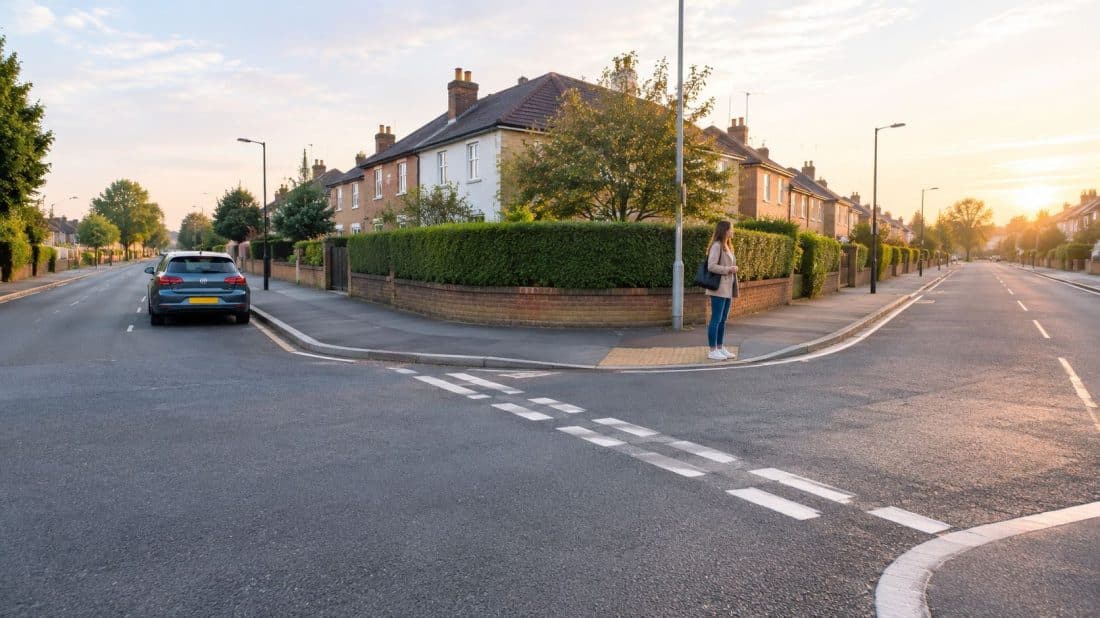
Highway Code Rule 243 says do not park within 10 metres of a junction, which is about two car lengths, unless you’re in an authorised parking space. In England and Wales, that guidance is advisory, but a car can still be dealt with if it causes danger or obstruction.
You might be sitting at the kerb right now, staring at a narrow street and wondering whether that gap is safe enough. The pressure is real, especially on tight residential roads where every space feels precious and junction corners already look cramped. For a learner, this isn’t just about squeezing into a space, it’s about reading the road, keeping sightlines open, and avoiding the sort of parking choice that makes other drivers, cyclists, and pedestrians uncomfortable.
That’s why highway code parking near a junction needs to be understood in plain English, not as a slogan to memorise. The core skill is judging distance, seeing when a bay changes the rule, and knowing when “allowed” still isn’t sensible. A calm instructor would break it down the same way we do on lesson: first the distance, then the visibility, then the legal context, then the practical decision.
If you want a reminder that parking practice matters during learning, this guide from Lendrum’s Driving School fits the same mindset. Good parking habits aren’t an extra, they’re part of safe driving from the start.
Table of Contents
- Introduction to Parking Near Junctions Safely
- What Highway Code Rule 243 Says About Junction Parking
- Why Parking Too Close to a Junction Is Dangerous
- Is Parking Near a Junction Illegal and How It Is Enforced
- How to Judge 10 Metres and Park Legally Near Junctions
- Common Mistakes Learners Make Near Junctions With Examples
- Key Takeaways for Safe and Test Ready Junction Parking
Introduction to Parking Near Junctions Safely
A learner rolls up to a side road and sees cars parked almost to the corner. The front of the junction feels hidden, the rear view mirror shows traffic behind, and the whole street suddenly looks tighter than it did from a distance. That’s the moment many people hesitate, because the question isn’t only “can I fit there”, it’s “can everyone else still see and move safely if I leave the car there”.
Parking near a junction matters because corners are where movement meets uncertainty. Drivers coming out of side roads need clear sightlines, pedestrians may step off the pavement, and cyclists can appear quickly from the main road. When a car sits too close to the corner, it changes the whole feel of the junction, even if the vehicle itself is stationary.
For learners in busy towns and suburbs, this comes up constantly. Streets with tight layouts, terraced housing, and limited driveways often push parking right up against junctions, so the pressure to “just squeeze in” can be strong. The problem is that a space that looks convenient can still be a poor choice if it hides the corner or forces others into awkward moves.
Practical rule: if the car makes you slow down and rethink the junction, it’s probably too close for comfort.
A good instructor doesn’t just teach a number, they teach a way of seeing. That means turning the rule into something you can picture on the road, then checking whether the space is usable, not just available. The rest of this guide does exactly that, from the official distance rule to the legal distinction that catches many learners out.
What Highway Code Rule 243 Says About Junction Parking
Rule 243 is simpler than many learners expect. It says drivers should not stop or park opposite or within 10 metres of a junction, unless they’re in an authorised parking space. GOV.UK repeats that same 10-metre distance for parking without lights on roads with a speed limit of 30 mph or less, as long as the vehicle is close to the kerb and facing traffic flow, and the official parking section covers rules 238 to 252 on the Highway Code site. Official Highway Code parking guidance for rules 238 to 252
The easiest way to picture 10 metres is about two car lengths. That helps more than trying to visualise a number on its own, because your brain already knows roughly how long a parked car looks on the street. If the space takes you right up to the corner, or if a second car would make the junction feel boxed in, you’re getting close to the limit.
Where the rule applies
The wording matters. It isn’t only about the side road you’re turning into, it also covers parking opposite a junction and on the approach to it. That means the danger zone is not just “right beside the corner”, it also includes positions that affect what drivers can see when they come out of the side road or approach from the main road.
Think of the junction as a small box where visibility is precious. If your vehicle sits inside that box, or presses too close to it, you’re not leaving enough room for normal movement. In a test, that can be enough to unsettle the examiner even before any legal question comes up.
A simple way to remember it
- Two car lengths: use that as your on-road mental picture.
- Corner space: if a parked car feels like it belongs to the junction rather than the road, it’s probably too close.
- Authorised bay first: a marked and signed bay can change the answer, but only if it really is designated for parking.
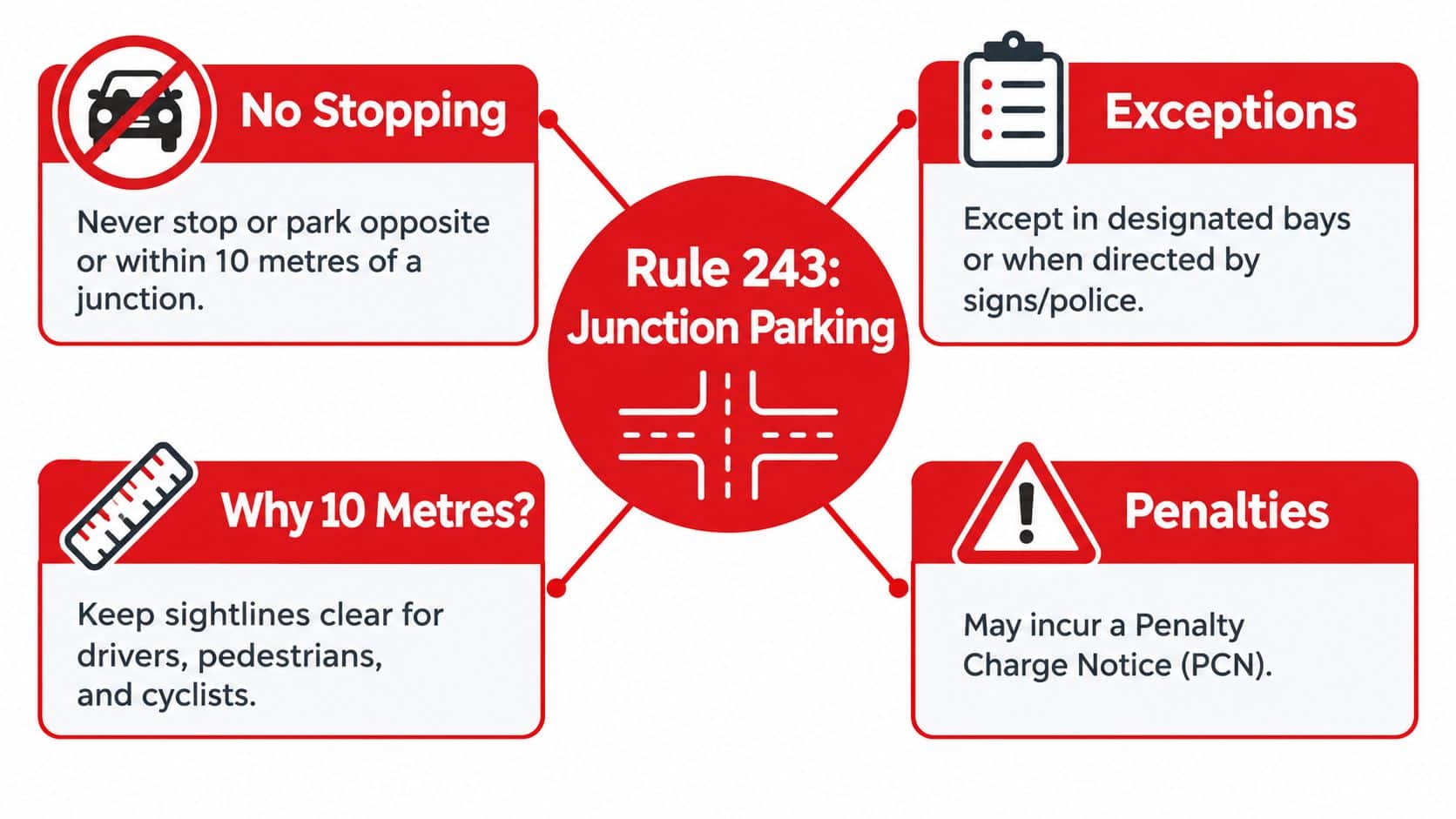
The phrase to remember is simple. Rule 243 gives you a distance, but it also gives you a safety boundary. If you can’t clearly judge that boundary, the safer choice is to keep going.
Why Parking Too Close to a Junction Is Dangerous
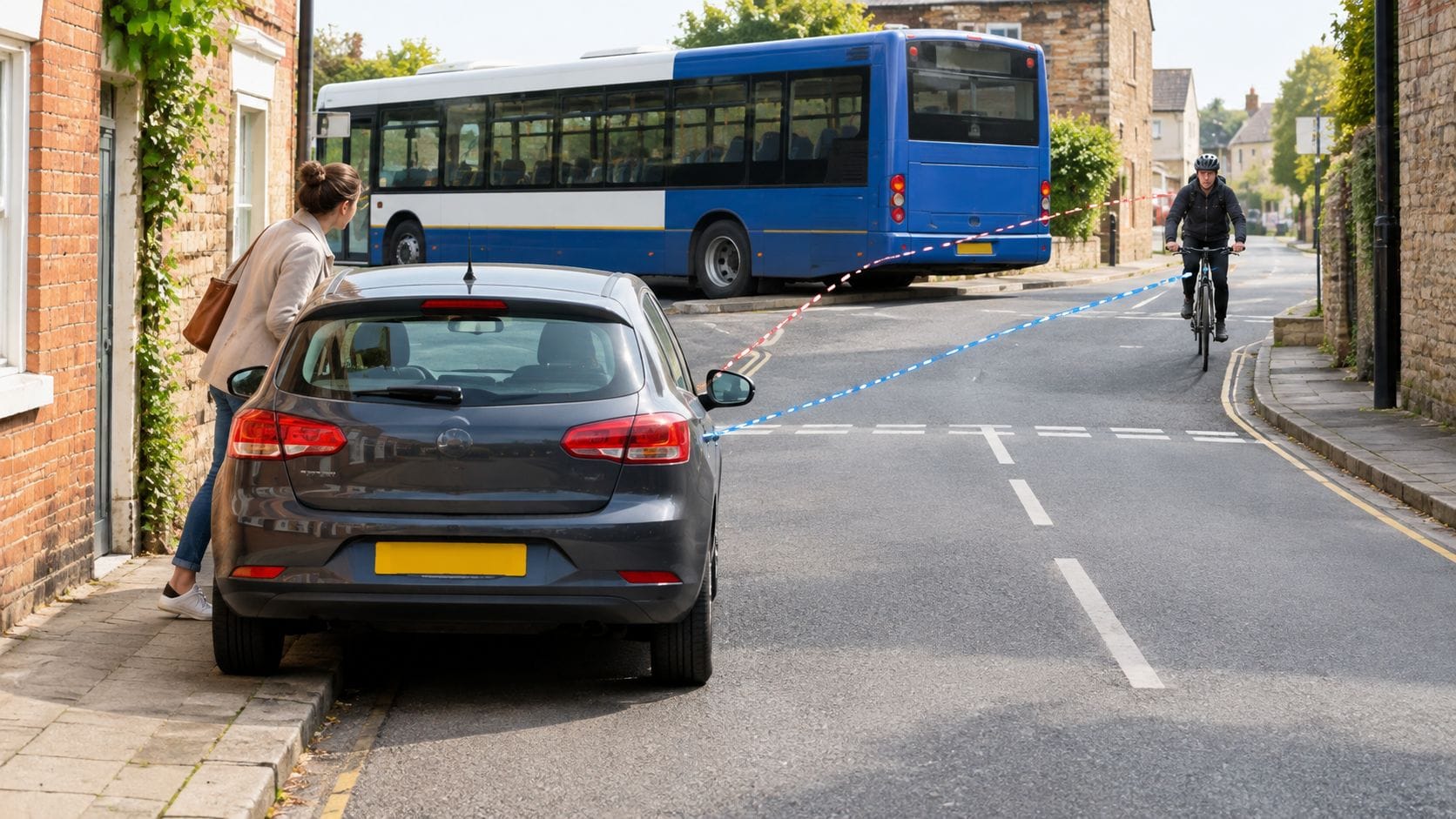
A junction works properly only when drivers can see enough of the road to make sensible decisions. A parked car near the corner blocks that view in the same way a wall blocks your ability to peek around it. If you’re emerging from a side road, you have less time to judge oncoming traffic, cyclists, or someone crossing the road, and the whole move becomes more hesitant.
That matters even when the parked vehicle is perfectly legal in some other context. A car can still force other drivers into awkward positioning, especially if larger vehicles need more room to turn. Buses and lorries have wider turning paths than a small car, so a badly placed parked vehicle can make a normal turn feel tight or clumsy, even if nobody breaks a formal rule in that moment.
The risk isn’t only about drivers. Pedestrians often cross near junctions because that’s where footpaths meet the road, and cyclists may move through the gap that a parked car has narrowed. If the vehicle hides the edge of the side road, people approaching the junction get less warning and more uncertainty. That’s why examiners notice judgement here, not just steering accuracy.
If a parked car makes another road user guess, the parking choice has already started to cause danger.
A learner sometimes thinks, “I’m not blocking the road, so it must be fine.” That’s too narrow. A car can remain fully within the kerb line and still create a problem by hiding the view of the junction, narrowing the usable carriageway, or forcing another driver to creep out further than they should. Those are the actual hazards instructors watch for on lesson.
Later on, the same logic helps with everyday driving too. A safe driver doesn’t only ask whether there’s physical space. They ask whether the space leaves the junction clear, the turning path workable, and the sightlines open enough for everyone else.
This video gives a good visual sense of how junction visibility changes when vehicles sit too close to the corner.
The safest habit is to treat the corner as a visibility zone, not just a parking zone. If the road users you’re trying to help can’t see clearly, the parking spot isn’t doing its job.
Is Parking Near a Junction Illegal and How It Is Enforced
This is the part that confuses a lot of learners. Rule 243 is guidance, not a standalone offence in England and Wales, and a Parliamentary briefing notes there isn’t a specific law that says “you can’t park near a junction”. But a vehicle can still be dealt with if it causes danger or obstruction under Section 22 of the Road Traffic Act 1988. Parliamentary briefing on parking near junctions
That means a driver shouldn’t read “advisory” as “safe to ignore”. Instructors still teach the rule as a hard safety standard because the practical outcome matters more than the label. If the car reduces visibility or narrows the road, it can still create a problem even where no specific junction-parking offence exists.
The position in Northern Ireland is stricter in one clear situation. The same Parliamentary briefing notes that parking on double yellow lines within 15 metres of a junction is not permitted there and can attract a penalty charge notice, although that 15-metre rule can’t be enforced on its own where there are no restriction markings. That’s another reason learners need to read the road markings as well as the spacing.
For anyone revising the wider legal picture, the article on essential driving laws UK is a useful companion, because parking rules make more sense when you see how signs, markings, and obstruction powers fit together. The key point is that road markings and local restrictions can matter as much as the Highway Code guidance itself.
| Situation | What Applies | Enforcement Risk |
|---|---|---|
| Parked opposite a junction in England and Wales | Highway Code guidance under Rule 243 | Advisory, but still risky if it creates obstruction or danger |
| Parked within the 10-metre guidance zone near a junction | Highway Code guidance under Rule 243 | Not automatically an offence on its own in England and Wales |
| Vehicle causing obstruction or danger | Section 22 of the Road Traffic Act 1988 | Can be acted against |
| Double yellow lines within 15 metres of a junction in Northern Ireland | Local restriction noted in the Parliamentary briefing | Can attract a penalty charge notice |
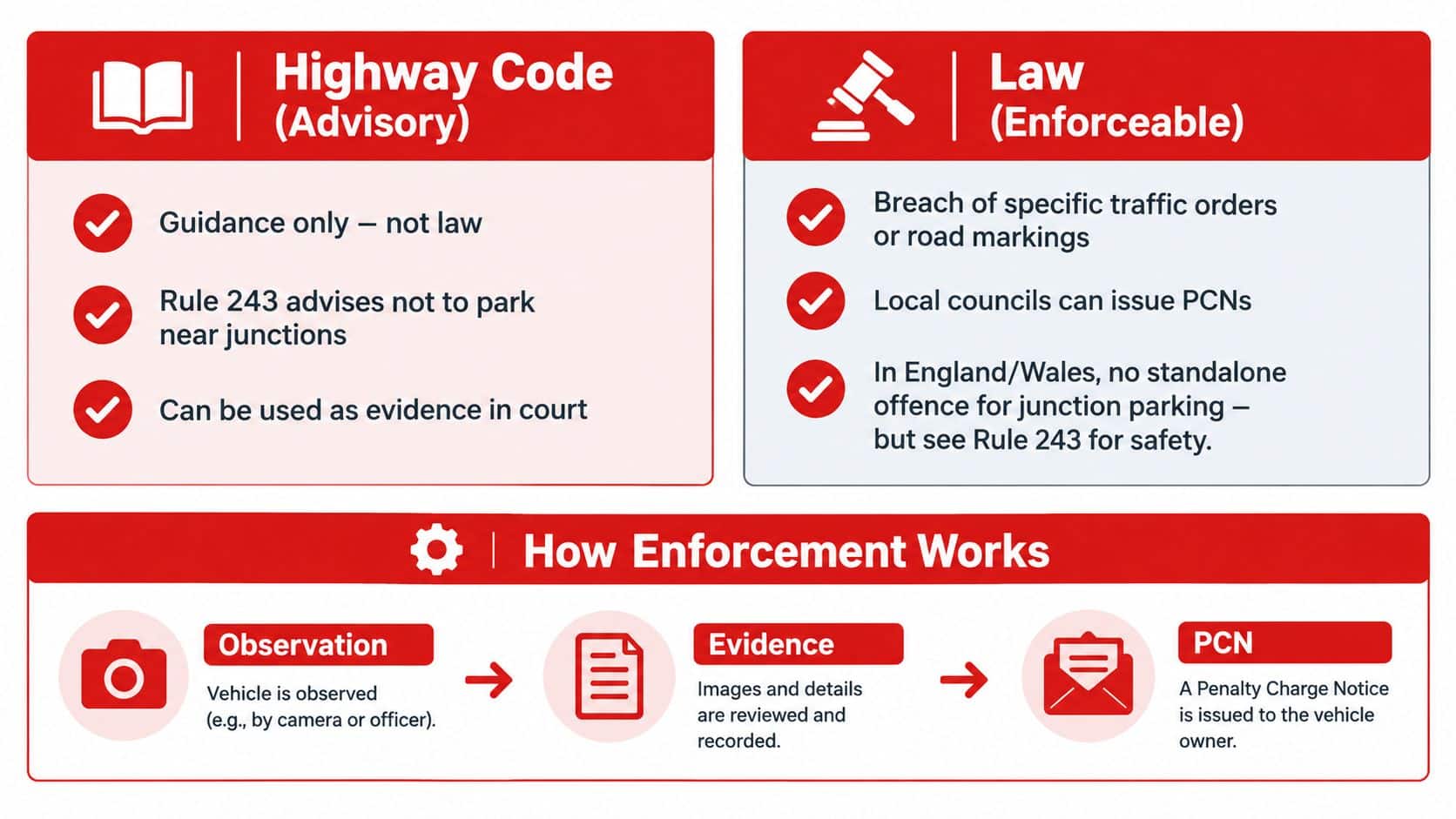
The clean way to think about it is this. Advisory doesn’t mean optional in practice, because obstruction, danger, and local restrictions can still turn a poor parking choice into an enforceable problem.
How to Judge 10 Metres and Park Legally Near Junctions
You don’t need a tape measure to make a good decision at the roadside. Start by treating 10 metres as about two car lengths, then compare the space with the parked cars already on the street. If your car would sit so close to the corner that a second car could barely fit between you and the junction, keep looking.
Ways to judge the space without guesswork
- Car length: one parked car gives you the first rough unit, and two give you the distance the Highway Code is pointing to.
- Street furniture: lampposts, bollards, and bins can help you compare spacing, but don’t use them as exact measuring tools.
- Kerb and markings: watch for double yellow lines, yellow zig-zags, dropped kerbs, and any signed bay that might change the rule.
- Authorised bays: if the road has a marked and signed bay, that can be the exception Rule 243 refers to.
- Visibility check: if the parked position would hide the corner from emerging traffic, don’t take it.
The decision comes from combining distance with road layout. A spot that looks acceptable on a straight road may become a poor choice on a bend, because the bend hides more of the junction than the same distance would on a flat, open stretch. That’s why learners should slow down, look twice, and ask whether the car would sit inside the junction’s visual space.
Use this test: if you’d have to explain the space to someone else with hand gestures, it’s probably too close to leave to chance.
If you’re unsure, move further away. That’s not over-cautious, it’s smart. A slightly longer walk from the car is far better than leaving a vehicle in a spot that confuses other drivers or puts you into a parking dispute later.
For learners who struggle with placing the car in relation to the kerb and other vehicles, the parallel parking guide helps build the same sense of spacing and vehicle position. The skill is the same one used near junctions, judging where the car sits in real space, not just in theory.
Common Mistakes Learners Make Near Junctions With Examples
A common error is to think the rule only applies to the junction you’re turning into. A learner sees a side road on the left, parks opposite it on the right, and assumes the car is clear because it’s “not at the corner”. In practice, that position can still reduce visibility for the side road and the main road, so the safe answer is to check both sides of the junction line, not just the one in front of you.
Another mistake is parking just before the supposed 10-metre point on a bend and trusting the eye too much. On a curved road, distance looks shorter than it really is, and the car can end up closer to the corner than the driver meant. A simple diagram helps here, imagine the car sitting inside the curve, with the junction tucked behind it, because that’s the position most likely to be judged too tight.
The third error is blocking a side road entrance while thinking it isn’t the main junction. Learners sometimes focus so hard on the corner that they miss a driveway, a turning mouth, or a gap that residents need. Even if the vehicle isn’t breaking an obvious line-marking rule, it can still create the same practical problem, less visibility and more awkward manoeuvring.
A fourth pattern is to treat a marked bay as a free pass without checking the signs. An authorised bay can change the answer, but only if it really is designated for parking there. If you see a bay, yellow lines, or unusual restrictions, slow down and read the whole setting rather than assuming the bay automatically wins.
For a broader view of what learners trip over in everyday driving, the common mistakes by first time drivers and how to avoid them article is useful alongside this one. The main lesson is simple, if a parking spot demands a guess, it’s usually the wrong spot for a learner.
Key Takeaways for Safe and Test Ready Junction Parking
A learner who parks near a junction needs a simple picture in mind. Keep highway code parking near a junction tied to three checks. First, judge 10 metres, which is about two car lengths. Second, ask whether the junction still feels open and easy to use. Third, look for an authorised bay or local marking that changes the position.
That order helps because parking is about more than fitting the car into a gap. It is about whether other road users can still see, turn, cross, and move without having to guess. A clear junction works like a clear doorway, people can pass through it without hesitation.
A small visual check can make the distance easier to judge. If your car sits roughly two average car lengths from the corner, you are in the right zone to think more carefully. If the junction lines up with the back of your car or feels tucked in close behind it, that is usually a sign to choose another space.
Use this quick checklist before you leave the car:
- Distance: am I clearly outside the two-car-length zone?
- Sightlines: can drivers at the junction still see properly?
- Markings: are there signs, lines, or a bay that change the rule?
- Common sense: would this spot annoy or endanger other road users?
If any answer feels uncertain, keep going. Calm judgement matters more than squeezing into the nearest space, especially when you are still building confidence. That habit helps on lessons and on the test.
Lendrum’s Driving School offers structured tuition for learners who want patient, supervised practice with parking, junctions, and other core manoeuvres in places such as Southampton, Portsmouth, Winchester, and Plymouth. If you’d like help turning the rule into road confidence, visit Lendrum’s Driving School and arrange lessons that fit your learning pace.
Book a lesson today
Book NowReady to pass your driving test with friendly, professional tuition and boost your confidence on the road? Book your lessons with Lendrum’s Driving School today and start your journey to becoming a safe, skilled driver.